


Page 395 - A GRAMMAR OF BHOJPURI _ PhD Dissertation 2020 TU
P. 395
Like the other Indo-Aryan languages, Bhojpuri has two types of transitive
                           verbs: simple transitive & ditransitive. Both exist in a pair of related sentences,

                           traditionally called active and prototypically promotional passive in which the topic-
                           of-passive can control verb agreement.  Moreover, passivization is also applied to
                           Bhojpuri intransitive verbs, known as prototypically non-promotional passive in

                           which the topic-of-passive retains its original case-marking, but the agent can be
                           overtly mentioned in an oblique case as promotional. Both types of Bhojpuri usage of

                           passive voice is also displayed in Tiwari (1854:261 and 1960:165), Nirbhik
                           (1975:129), Tripathy (1987:258), Shrivastava (1999:91), Sharma and Ashk (2007:92),

                           Thakur (2011:124) and Singh (2013:105).
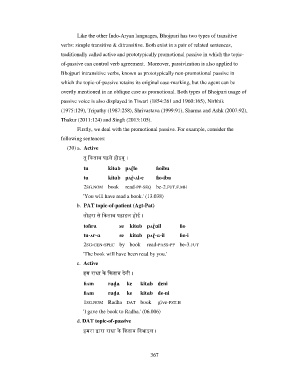
                                 Firstly, we deal with the promotional passive. For example, consider the

                           following sentences:
                             (30) a.  Active

                                    तू ;कताब पढ़ले होइबू ।
                                    tu        kitɑb  pʌɽ ̊ le     ɦoibu

                                    tu        kitɑb  pʌɽ ̊ -ʌl-e   ɦo-ibu
                                    2SG.NOM  book  read-PP-SEQ  be-2.FUT.F.MH

                                    'You will have read a book.' (13.038)
                                 b.  PAT topic-of-patient (Agt-Pat)
                                    तोहरा से ;कताब पढ़ाइल होई ।

                                    toɦrɑ          se  kitɑb  pʌɽ ̊ ɑil       ɦo

                                    tu-ʌr-ɑ        se  kitɑb  pʌɽ ̊ -ɑ-il   ɦo-i
                                    2SG-GEN-SPEC  by  book  read-PASS-PP  be-3.FUT

                                    'The book will have been read by you.'
                                 c.  Active

                                    हम राधा के ;कताब देनी ।
                                    ɦʌm       rɑd ̤ ɑ   ke   kitɑb  deni

                                    ɦʌm       rɑd ̤ ɑ   ke   kitɑb  de-ni
                                    1SG.NOM  Radha  DAT  book  give-PST.H

                                    'I gave the book to Radha.' (06.006)
                                 d. DAT topic-of-passive

                                    हमरा kारा राधा के ;कताब ;दआइल ।


                                                                367

