


Page 392 - A GRAMMAR OF BHOJPURI _ PhD Dissertation 2020 TU
P. 392
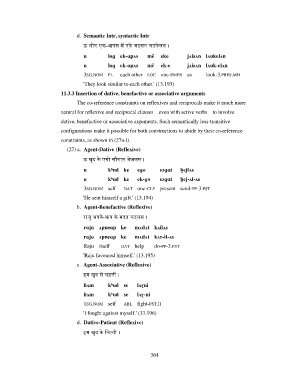
d. Semantic Intr, syntactic Intr
ऊ लोग एक-आपस म) एके जइसन लउकेलन ।
u loɡ ek-ɑpʌs mẽ eke jʌisʌn lʌukelʌn
u loɡ ek-ɑpʌs mẽ ek-e jʌisʌn lʌuk-elʌn
3SG.NOM PL each other LOC one-EMPH as look-3.PRES.MH
'They look similar to each other.' (13.193)
11.3.3 Insertion of dative, benefactive or associative arguments
The co-reference constraints on reflexives and reciprocals make it much more
natural for reflexive and reciprocal clauses even with active verbs to involve
dative, benefactive or associative arguments. Such semantically less-transitive
configurations make it possible for both constructions to abide by their co-reference
conatraints, as shown in (27a-i).
(27) a. Agent-Dative (Reflexive)
ऊ खुद के एगो सौगात भेजलस ।
u kʰud ke eɡo sɔɡɑt b ̤ ejlʌs
u kʰud ke ek-ɡo sɔɡɑt b ̤ ej-ʌl-ʌs
3SG.NOM self DAT one-CLF present send-PP-3.PST
'He sent himself a gift.' (13.194)
b. Agent-Benefactive (Reflexive)
राजु अपने-आप के मदत कइलस ।
rɑju ʌpneɑp ke mʌdʌt kʌilʌs
rɑju ʌpneɑp ke mʌdʌt kʌr-il-ʌs
Raju itself DAT help do-PP-3.PST
'Raju favoured himself.' (13.195)
c. Agent-Associative (Reflexive)
हम खुद से लड़नी ।
ɦʌm kʰud se lʌɽni
ɦʌm kʰud se lʌɽ-ni
1SG.NOM self ABL fight-PST.H
'I fought against myself.' (13.196)
d. Dative-Patient (Reflexive)
हम खुद के िचdनी ।
364

