


Page 394 - A GRAMMAR OF BHOJPURI _ PhD Dissertation 2020 TU
P. 394
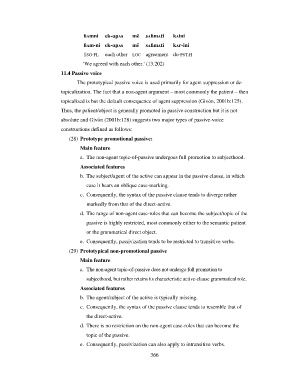
ɦʌmni ek-ɑpʌs mẽ sʌɦmʌti kʌini
ɦʌm-ni ek-ɑpʌs mẽ sʌɦmʌti kʌr-ini
1SG-PL each other LOC agreement do-PST.H
'We agreed with each other.' (13.202)
11.4 Passive voice
The prototypical passive voice is used primarily for agent suppression or de-
topicalization. The fact that a non-agent argument most commonly the patient then
topicalized is but the default consequence of agent suppression (Givón, 2001b:125).
Thus, the patient/object is generally promoted in passive construction but it is not
absolute and Givón (2001b:128) suggests two major types of passive-voice
constructions defined as follows:
(28) Prototype promotional passive:
Main feature
a. The non-agent topic-of-passive undergoes full promotion to subjecthood.
Associated features
b. The subject/agent of the active can appear in the passive clause, in which
case it bears an oblique case-marking.
c. Consequently, the syntax of the passive clause tends to diverge rather
markedly from that of the direct-active.
d. The range of non-agent case-roles that can become the subject/topic of the
passive is highly restricted, most commonly either to the semantic patient
or the grammatical direct object.
e. Consequently, passivization tends to be restricted to transitive verbs.
(29) Prototypical non-promotional passive
Main feature
a. The non-agent topic-of-passive does not undergo full promotion to
subjecthood, but rather retains its characteristic active-clause grammatical role.
Associated features
b. The agent/subject of the active is typically missing.
c. Consequently, the syntax of the passive clause tends to resemble that of
the direct-active.
d. There is no restriction on the non-agent case-roles that can become the
topic of the passive.
e. Consequently, passivization can also apply to intransitive verbs.
366

