


Page 396 - A GRAMMAR OF BHOJPURI _ PhD Dissertation 2020 TU
P. 396
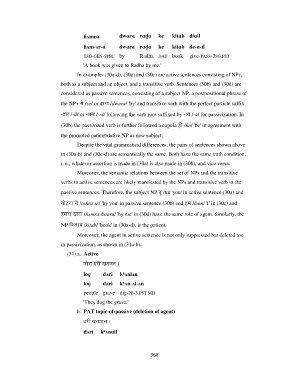
ɦʌmr ɑ         dwɑrɑ  rɑd ̤ ɑ   ke   kitɑb  diɑil

                                    ɦʌm-ʌr-ɑ       dwɑrɑ  rɑd ̤ ɑ   ke   kitɑb  de-ɑ-il
                                    1SG-GEN-SPEC  by       Radha  DAT  book  give-PASS-3SG.PST
                                    'A book was given to Radha by me.'

                                 In examples (30a-d), (30a) and (30c) are active sentences consisting of NPs,
                           both as a subject and an object, and a transitive verb. Sentences (30b) and (30d) are

                           considered as passive sentences, consisting of a subject NP, a postpositional phrase of
                           the NP+ से /se/ or kारा /dw ɑrɑ/ 'by' and transitive verb with the perfect particle suffix

                           -इल /-il/ or -अल /-ʌl/ following the verb root suffixed by -आ /-ɑ/ for passivization. In

                           (30b) the passivized verb is further followed a copula हो /ɦo/ 'be' in agreement with

                           the promoted patient/dative NP as new subject.
                                 Despite the vital grammatical differences, the pairs of sentences shown above

                           in (30a-b) and (30c-d) are semantically the same. Both have the same truth condition,
                           i. e., whatever assertion is made in (30a) is also made in (30b), and vice versa.
                                 Moreover, the semantic relations between the set of NPs and the transitive

                           verbs in active sentences are likely manifested by the NPs and transitive verb in the

                           passive sentences. Therefore, the subject NP तू /tu/ 'you' in active sentence (30a) and
                           तोहरा से /toɦrɑ se/ 'by you' in passive sentence (30b) and हम /ɦʌm/ 'I' in (30c) and

                           हमरा kारा /ɦʌmrɑ dwɑrɑ/ 'by me' in (30d) have the same role of agent. Similarly, the

                           NP ;कताब /kit ɑb/ 'book' in (30a-d), is the patient.

                                 Moreover, the agent in active sentence is not only suppressed but deleted too
                           in passivization, as shown in (31a-b).

                             (31) a.  Active
                                    लोग दरी खनलन ।

                                    loɡ     dʌri   kʰʌnlʌn
                                    loɡ     dʌri   kʰʌn-ʌl-ʌn

                                    people  grave  dig-PP-3.PST.MH
                                    'They dug the grave.'

                                 b.  PAT topic-of-passive (deletion of agent)
                                    दरी खनाइल ।

                                    dʌri   kʰʌnɑil


                                                                368

