


Page 391 - A GRAMMAR OF BHOJPURI _ PhD Dissertation 2020 TU
P. 391
u         loɡ  ʌpne-ʌpne  ke     cun-ʌl-ʌn
                                    3SG.NOM  PL    self        DAT  elect  -3.PST.H

                                    'They elected themselves.' (13.192)
                           11.3.2 Reciprocals
                                 "Two (or more) like events, coded by the very same verb, are represented jointly

                           in a single clause, with the subject of the first being the object of the second, and vice
                           versa. The two participants are thus reciprocally co-referent and act upon (or relate to)

                           each other" (Givón, 2001b: 96). "Syntactically, a reciprocal construction represents the
                           two states/events as a single clause, where the two reciprocal participants are

                           represented as the conjoined subjects of the clause, and the object is either zero-marked
                           or replaced by some reciprocal marker or pronoun" (Givon 2011:245-6).

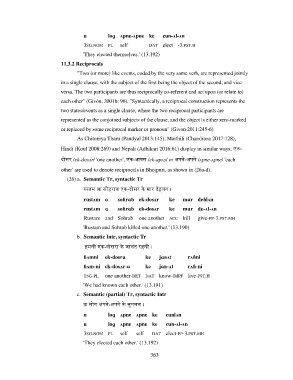
                                 As Chitoniya Tharu (Paudyal 2013:145), Maithili (Chandrana 2017:128),
                           Hindi (Koul 2008:269) and Nepali (Adhikari 2016:61) display in similar ways, एक-

                           दोसर /ek-dosʌr/ 'one another', एक-आपस /ek-ɑpʌs/ or अपने-अपने /ʌpne-ʌpne/ 'each

                           other' are used to denote reciprocals in Bhojpuri, as shown in (26a-d).
                             (26) a.  Semantic Tr, syntactic Tr

                                    cbतम आ सोहराब एक-दोसर के मार देहलन ।

                                    rustʌm  ɑ     soɦrɑb  ek-dosʌr      ke   mɑr  deɦlʌn
                                    rustʌm  ɑ     soɦrɑb  ek-dosʌr      ke   mɑr  de-ʌl-ʌn
                                    Rustam  and  Sohrab  one another  ACC  kill     give-PP-3.PST.MH

                                    'Rustam and Sohrab killed one another.' (13.190)
                                 b.  Semantic Intr, syntactic Tr

                                     हमनी एक-दोसरा के जानत रहनी ।
                                    ɦʌmni  ek-dosrɑ           ke    jɑnʌt       rʌɦni

                                    ɦʌm-ni  ek-dosʌr-ɑ        ke    jɑn-ʌt      rʌɦ-ni
                                    1SG-PL  one another-DET  DAT  know-IMPF  live-PST.H

                                    'We had known each other.' (13.191)
                                 c.  Semantic (partial) Tr, syntactic Intr

                                    ऊ लोग अपने-अपने के चुनलन ।

                                    u         loɡ  ʌpne  ʌpne  ke     cunlʌn
                                    u         loɡ  ʌpne  ʌpne  ke     cun-ʌl-ʌn
                                    3SG.NOM  PL    self   self   DAT  elect-PP-3.PST.MH

                                    'They elected each other.' (13.192)

                                                                363

