


Page 277 - A GRAMMAR OF BHOJPURI _ PhD Dissertation 2020 TU
P. 277
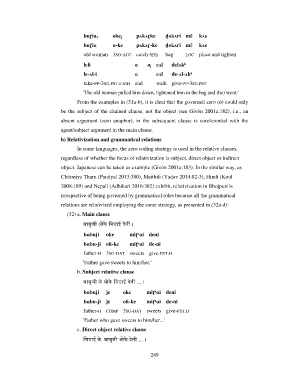
pʌkʌɽke    d ̤ okʌri  mẽ  kʌs
                                    buɽ ̊ iɑ i   oke j
                                    buɽ ̊ iɑ    u-ke      pʌkʌɽ-ke    d ̤ okʌri  mẽ  kʌs

                                    old woman  3SG-ACC  catch-SEQ     bag      LOC  place and tighten

                                    leli                 ɑ     ø j  cʌl   delʌkʰ
                                    le-ʌl-i              ɑ        cʌl    de-ʌl-ʌkʰ
                                    take-PP-3SG.PST.F.MH  and     walk  give-PP-3SG.PST

                                    'The old woman pulled him down, tightened him in the bag and (he) went.'
                                 From the examples in (31a-b), it is clear that the governed zero (ø) could only
                           be the subject of the chained clause, not the object (see Givόn 2001a:182), i.e., an

                           absent  argument  (zero  anaphor),  in  the  subsequent  clause  is  coreferential  with  the
                           agent/subject argument in the main clause.

                           h) Relativization and grammatical relations
                                 In some languages, the zero coding strategy is used in the relative clauses,

                           regardless of whether the focus of relativization is subject, direct object or indirect
                           object. Japanese can be taken as example (Givόn 2001a:183). In the similar way, as

                           Chitoniya Tharu (Paudyal 2013:380), Maithili (Yadav 2014:82-3), Hindi (Koul
                           2008:189) and Nepali (Adhikari 2016:382) exhibit, relativization in Bhojpuri is
                           irrespective of being governed by grammatical roles because all the grammatical

                           relations are relativized employing the same strategy, as presented in (32a-d):
                             (32) a. Main clause

                                    बाबुजी ओके िमठाई देनी ।

                                    bɑbuji   oke       miʈʰɑi  deni
                                    bɑbu-ji  oɦ-ke     miʈʰɑi  de-ni
                                    father-H  3SG-DAT  sweets  give-PST.H

                                    'Father gave sweets to him/her.'
                                 b. Subject relative clause

                                    बाबुजी जे ओके िमठाई देनी ... ।

                                    bɑbuji   je     oke       miʈʰɑi  deni
                                    bɑbu-ji  je     oɦ-ke     miʈʰɑi  de-ni
                                    father-H  COMP  3SG-DAT  sweets  give-PST.H

                                    'Father who gave sweets to him/her...'
                                 c. Direct object relative clause

                                    िमठाई जे  बाबुजी ओके देनी ... ।


                                                                249

