


Page 274 - A GRAMMAR OF BHOJPURI _ PhD Dissertation 2020 TU
P. 274
the subject or the object of the main clause" (Craig 1977:311). Brainard (1997:122)
                           notes "equi-NP deletion takes place between a main clause and complement clause:

                           when an argument in the main clause is co-referential with one in the complement
                           clause, the co-referential complement argument is deleted". Subject of the main
                           clause, especially the nominative one in either of the intransitive and transitive

                           clauses, controls such deletion. Thus, as Maithili (Yadav 2014:88-9), Nepali
                           (Adhikari 2016:417-9) and Hindi (Koul 2008:188-9) display, the equi-NP deletion (or

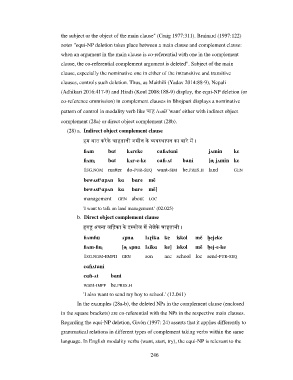
                           co-reference ommission) in complement clauses in Bhojpuri displays a nominative
                           pattern of control in modality verb like चाह /cɑɦ/ 'want' either with indirect object

                           complement (28a) or direct object complement (28b).

                             (28) a.  Indirect object complement clause
                                    हम बात करेके चाहतानी जमीन के OवPथापन का बारे म; ।

                                    ɦʌm       bɑt     kʌreke       cɑɦʌtɑni             jʌmin      ke

                                    ɦʌm i     bɑt     kʌr-e-ke     cɑɦ-ʌt    bɑni       [ø i jʌmin  ke
                                    1SG.NOM  matter  do-PUR-SEQ  want-SIM  be.PRES.H  land         GEN

                                    bewʌstʰɑpʌn  kɑ     bɑre  mẽ
                                    bewʌstʰɑpʌn  kɑ     bɑre  mẽ]
                                    management    GEN  about  LOC

                                    'I want to talk on land management.' (02.025)
                                 b.  Direct object complement clause

                                    हमR अपना लिड़का के इPकोल म; भेजेके चाहतानी ।
                                    ɦʌmɦu           ʌpnɑ      lʌɽikɑ  ke  iskol    mẽ  b ̤ ejeke

                                                    [ø i ʌpnɑ  lʌikɑ   ke]  iskol   mẽ  b ̤ ej-e-ke
                                    ɦʌm-ɦu i
                                    1SG.NOM-EMPH  GEN         son     acc  school  loc  send-PUR-SEQ

                                    cɑɦʌtɑni
                                    cɑɦ-ʌt     bɑni

                                    want-IMPF  be.PRES.H
                                    'I also want to send my boy to school.' (12.041)

                                 In the examples (28a-b), the deleted NPs in the complement clause (enclosed
                           in the square brackets) are co-referential with the NPs in the respective main clauses.

                           Regarding the equi-NP deletion, Givόn (1997: 24) asserts that it applies differently to
                           grammatical relations in different types of complement taking verbs within the same
                           language. In English modality verbs (want, start, try), the equi-NP is relevant to the


                                                                246

