


Page 269 - A GRAMMAR OF BHOJPURI _ PhD Dissertation 2020 TU
P. 269
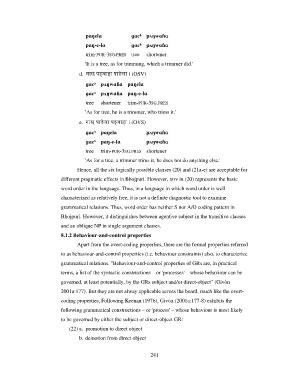
pɑŋelɑ ɡɑcʰ pʌŋwɑɦɑ
pɑŋ-e-lɑ ɡɑcʰ pʌŋwɑɦɑ
trim-PUR-3SG.PRES tree shortener
'It is a tree, as for trimming, which a trimmer did.'
d. गाछ प"वाहा पाङेला । (OSV)
ɡɑcʰ pʌŋwɑɦɑ pɑŋelɑ
ɡɑcʰ pʌŋwɑɦɑ pɑŋ-e-lɑ
tree shortener trim-PUR-3SG.PRES
'As for tree, he is a trimmer, who trims it.'
e. गाछ पाङेला प"वाहा । (OVS)
ɡɑcʰ pɑŋelɑ pʌŋwɑɦɑ
ɡɑcʰ pɑŋ-e-lɑ pʌŋwɑɦɑ
tree trim-PUR-3SG.PRES shortener
'As for a tree, a trimmer trims it, he does not do anything else.'
Hence, all the six logically possible clauses (20) and (21a-e) are acceptable for
different pragmatic effects in Bhojpuri. However, SOV in (20) represents the basic
word order in the language. Thus, in a language in which word order is well
characterized as relatively free, it is not a definite diagnostic tool to examine
grammatical relations. Thus, word order has neither S nor A/O coding pattern in
Bhojpuri. However, it distinguishes between agentive subject in the transitive clauses
and an oblique NP in single argument clauses.
8.1.2 Behaviour-and-control properties
Apart from the overt-coding properties, there are the formal properties referred
to as behaviour-and-control properties (i.e. behaviour constraints) also, to characterize
grammatical relations. "Behaviour-and-control properties of GRs are, in practical
terms, a list of the syntactic constructions or 'processes' whose behaviour can be
governed, at least potentially, by the GRs subject and/or direct-object" (Givón
2001a:177). But they are not alway applicable across the board, much like the overt-
coding properties, Following Keenan (1976), Givón (2001a:177-8) exhibits the
following grammatical constructions or 'process' whose behaviour is most likely
to be governed by either the subject or direct-object GR:
(22) a. promotion to direct object
b. demotion from direct object
241

