


Page 270 - A GRAMMAR OF BHOJPURI _ PhD Dissertation 2020 TU
P. 270
c. passivization
                                  d. reflexivization

                                  e. causativization
                                  f.  equi-NP reference in complementation
                                  g. raising

                                  h. possessor raising
                                  i.  anaphoric co-reference in chained clauses

                                  j.  relativization
                                  k. wh-questions

                                  l.  cleft-focus constructions
                                  m. participial adverbial clauses

                                 These properties of GRs may be applicable in a particular construction in a
                           particular language, determined whether one has to mention the subject and/or direct-
                           object GR in describing the grammatical behaviour of a particular construction.

                           Moreover, in a nominative-accusative language like Bhojpuri, the morphology does
                           not reveal unified categories of subject and direct object.

                                 We examine the patterns of syntactic control in some syntactic constructions
                           in the language as follows:

                           a) Promotion to or demotion from direct object
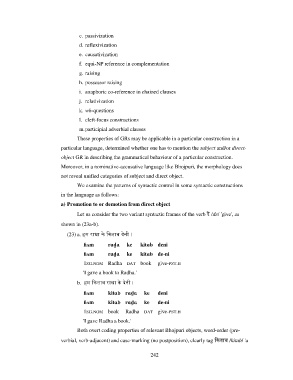
                                 Let us consider the two variant syntactic frames of the verb दे /de/ 'give', as

                           shown in (23a-b).

                             (23) a. हम राधा के .कताब देनी ।
                                    ɦʌm       rɑd ̤ ɑ   ke   kitɑb  deni

                                    ɦʌm       rɑd ̤ ɑ   ke   kitɑb  de-ni
                                    1SG.NOM  Radha  DAT  book  give-PST.H
                                    'I gave a book to Radha.'

                                 b.  हम .कताब राधा के देनी ।

                                    ɦʌm       kitɑb  rɑd ̤ ɑ   ke   deni
                                    ɦʌm       kitɑb  rɑd ̤ ɑ   ke   de-ni

                                    1SG.NOM  book  Radha  DAT  give-PST.H
                                    'I gave Radha a book.'

                                 Both overt coding properties of relevant Bhojpuri objects, word-order (pre-
                           verbial, verb-adjacent) and case-marking (no postposition), clearly tag .कताब /kitɑb/ 'a


                                                                242

