


Page 267 - A GRAMMAR OF BHOJPURI _ PhD Dissertation 2020 TU
P. 267
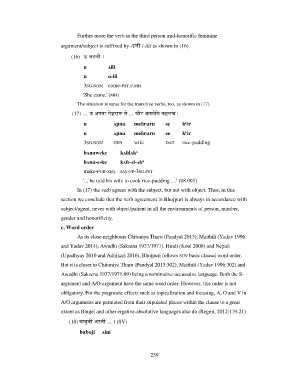
Further more the verb in the third person mid-honorific feminine
argument/subject is suffixed by -इली /-ili/ as shown in (16).
(16) ऊ अइली ।
u ʌili
u ɑ-ili
3SG.NOM come-PST.F.MH
'She came.' (MH)
The situation is same for the transitive verbs, too, as shown in (17).
(17) ... ऊ अपना मेहराD से ... खीर बनावेके कहलख ।
u ʌpnɑ meɦrɑru se kʰir
u ʌpnɑ meɦrɑru se kʰir
3SG.NOM GEN wife DAT rice-pudding
bʌnɑweke kʌɦlʌkʰ
bʌnɑ-e-ke kʌɦ-ʌl-ʌkʰ
make-PUR-SEQ say-PP-3SG.PST
'... he told his wife to cook rice-pudding
' (08.005)
In (17) the verb agrees with the subject, but not with object. Thus, in this
section we conclude that the verb agreement in Bhojpuri is always in accordance with
subject/agent, never with object/patient in all the environments of person, number,
gender and honorificity.
c. Word order
As its close neighbours Chitoniya Tharu (Paudyal 2013), Maithili (Yadav 1996
and Yadav 2014), Awadhi (Saksena 1937/1971), Hindi (Koul 2008) and Nepali
(Upadhyay 2010 and Adhikari 2016), Bhojpuri follows SOV basic clausal word order.
But it is closer to Chitoniya Tharu (Paudyal 2013:302), Maithili (Yadav 1996:302) and
Awadhi (Saksena 1937/1971:99) being a nominative-accusative language. Both the S-
argument and A/O-argument have the same word order. However, this order is not
obligatory. For the pragmatic effects such as topicalization and focusing, A, O and V in
A/O arguments are permuted from their stipulated places within the clause to a great
extent as Bhujel and other ergative-absolutive languages also do (Regmi, 2012:119-21).
(18) बाबुजी अइनी ... । (SV)
bɑbuji ʌini
239

