


Page 263 - A GRAMMAR OF BHOJPURI _ PhD Dissertation 2020 TU
P. 263
u         mɑȷ ̈    ɡ ̈ ʌr   mẽ  rʌɦ-ele
                                    3SG.NOM  middle  house  LOC  live-3SG.PRES.F

                                    'She lives in the middle room.'
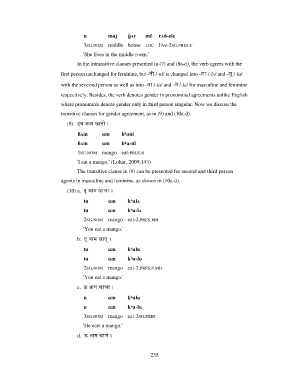
                                 In the intransitive clauses presented in (7) and (8a-d), the verb agrees with the

                           first person unchanged for feminine, but -नी /-ni/ is changed into -लऽ /-lʌ/ and -लू /-lu/

                           with the seocond person as well as into -ला /-lɑ/ and -ले /-le/ for masculine and feminine
                           respectively. Besides, the verb denotes gender in pronominal agreements unlike English

                           where pronominls denote gender only in third person singular. Now we discuss the
                           transitive clauses for gender agreement, as in (9) and (10a-d).

                             (9)  हम आम खानी ।
                                 ɦʌm        ɑm      kʰɑni

                                 ɦʌm        ɑm      kʰɑ-ni
                                 1SG.NOM  mango  eat-PRES.H

                                 'I eat a mango.' (Lohar, 2009:143)
                                 The transitive clause in (9) can be presented for second and third person
                           agents in masculine and feminine, as shown in (10a-d).

                             (10) a.  तू आम खालऽ ।

                                    tu        ɑm      kʰɑlʌ
                                    tu        ɑm      kʰɑ-lʌ

                                    2SG.NOM  mango  eat-2.PRES.MH
                                    'You eat a mango.'

                                 b.  तू आम खालू ।
                                    tu        ɑm      kʰɑlu

                                    tu        ɑm      kʰɑ-lu
                                    2SG.NOM  mango  eat-2.PRES.F.MH

                                    'You eat a mango.'
                                 c.  ऊ आम खाला ।

                                    u         ɑm      kʰɑlɑ

                                    u         ɑm      kʰɑ-lɑ
                                    3SG.NOM  mango  eat-3SG.PRES
                                    'He eats a mango.'

                                 d.  ऊ आम खाले ।


                                                                235

