


Page 260 - A GRAMMAR OF BHOJPURI _ PhD Dissertation 2020 TU
P. 260
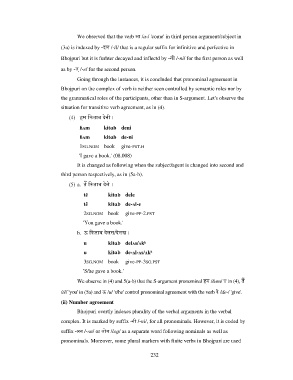
We observed that the verb आ /ɑ-/ 'come' in third person argument/subject in

                           (3a) is indexed by -इल /-il/ that is a regular suffix for infinitive and perfective in

                           Bhojpuri but it is furhter decayed and inflectd by -नी /-ni/ for the first person as well

                           as by -ए /-e/ for the second person.
                                 Going through the instances, it is concluded that pronominal agreement in

                           Bhojpuri on the complex of verb is neither seen controlled by semantic roles nor by
                           the grammatical roles of the participants, other than in S-argument. Let's observe the

                           situation for transitive verb agreement, as in (4).
                              (4)   हम .कताब देनी ।

                                  ɦʌm       kitɑb  deni
                                  ɦʌm       kitɑb  de-ni

                                  1SG.NOM  book  give-PST.H
                                  'I gave a book.' (08.008)
                                 It is changed as following when the subject/agent is changed into second and

                           third person respectively, as in (5a-b).

                              (5) a.  तेँ .कताब देले ।
                                    tẽ        kitɑb  dele

                                    tẽ        kitɑb  de-ʌl-e
                                    2SG.NOM  book  give-PP-2.PST

                                    'You gave a book.'
                                 b.  ऊ .कताब देलस/देलख ।

                                    u         kitɑb  delʌs/ʌkʰ
                                    u         kitɑb  de-ʌl-ʌs/ʌkʰ

                                    3SG.NOM  book  give-PP-3SG.PST
                                    'S/he gave a book.'
                                 We observe in (4) and 5(a-b) that the S-argument pronominal हम /ɦʌm/ 'I' in (4), तेँ


                           /tẽ/ 'you' in (5a) and ऊ /u/ 's/he' control pronominal agreement with the verb दे /de-/ 'give'.
                           (ii) Number agreement

                                 Bhojpuri overtly indexes plurality of the verbal arguments in the verbal
                           complex. It is marked by suffix -नी /-ni/, for all pronominals. However, it is coded by

                           suffix -अन /-ʌn/ or लोग /loɡ/ as a separate word following nominals as well as
                           pronominals. Moreover, some plural markers with finite verbs in Bhojpuri are used


                                                                232

