


Page 259 - A GRAMMAR OF BHOJPURI _ PhD Dissertation 2020 TU
P. 259
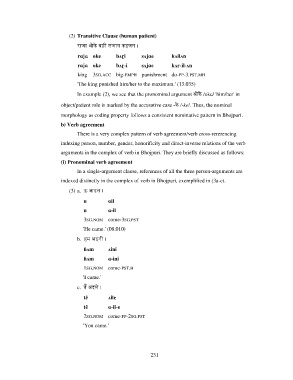
(2) Transitive Clause (human patient)
                                 राजा ओके बड़ी सजाय कइलन ।

                                 rɑjɑ  oke        bʌɽi      sʌjɑe        kʌilʌn
                                 rɑjɑ  oke        bʌɽ-i     sʌjɑe        kʌr-il-ʌn

                                 king  3SG.ACC  big-EMPH  punishment  do-PP-3.PST.MH
                                 'The king punished him/her to the maximum.' (13.035)

                                 In example (2), we see that the pronominal argument ओके /oke/ 'him/her' in

                           object/patient role is marked by the accusative case -के /-ke/. Thus, the nominal

                           morphology as coding property follows a consistent nominative pattern in Bhojpuri.
                           b) Verb agreement
                                 There is a very complex pattern of verb agreement/verb cross-rererencing

                           indexing person, number, gender, honorificity and direct-inverse relations of the verb
                           arguments in the complex of verb in Bhojpuri. They are briefly discussed as follows:

                           (i) Pronominal verb agreement
                                 In a single-argument clause, references of all the three person-arguments are
                           indexed distinctly in the complex of verb in Bhojpuri, exemplified in (3a-c).

                              (3) a.  ऊ आइल ।

                                    u         ɑil
                                    u         ɑ-il

                                    3SG.NOM  come-3SG.PST
                                    'He came.' (08.010)

                                 b.  हम अइनी ।
                                    ɦʌm       ʌini

                                    ɦʌm       ɑ-ini
                                    1SG.NOM  come-PST.H

                                    'I came.'
                                 c.  तेँ अइले ।

                                    tẽ        ʌile

                                    tẽ        ɑ-il-e
                                    2SG.NOM  come-PP-2SG.PST
                                    'You came.'


                                                                231

