


Page 264 - A GRAMMAR OF BHOJPURI _ PhD Dissertation 2020 TU
P. 264
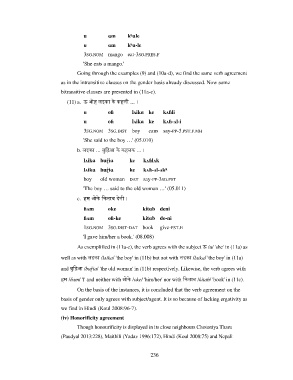
u ɑm kʰɑle
u ɑm kʰɑ-le
3SG.NOM mango eat-3SG.PRES.F
'She eats a mango.'
Going through the examples (9) and (10a-d), we find the same verb agreement
as in the intransitive clauses on the gender basis already discussed. Now some
bitransitive clauses are presented in (11a-c).
(11) a. ऊ ओह लइका के कहली ... ।
u oɦ lʌikɑ ke kʌɦli
u oɦ lʌikɑ ke kʌɦ-ʌl-i
3SG.NOM 3SG.DIST boy caus say-PP-3.PST.F.MH
'She said to the boy
' (05.010)
b. लइका ... बु.ढ़आ के कहलक ... ।
lʌikɑ buɽ ̊ iɑ ke kʌɦlʌk
lʌikɑ buɽ ̊ iɑ ke kʌɦ-ʌl-ʌkʰ
boy old woman DAT say-PP-3SG.PST
'The boy
said to the old woman
' (05.011)
c. हम ओके .कताब देनी ।
ɦʌm oke kitɑb deni
ɦʌm oɦ-ke kitɑb de-ni
1SG.NOM 3SG.DIST-DAT book give-PST.H
'I gave him/her a book.' (08.008)
As exemplified in (11a-c), the verb agrees with the subject ऊ /u/ 'she' in (11a) as
well as with लइका /lʌika/ 'the boy' in (11b) but not with लइका /lʌika/ 'the boy' in (11a)
and बु.ढ़आ /buɽ ̊ iɑ/ 'the old woman' in (11b) respectively. Likewise, the verb agrees with
हम /ɦʌm/ 'I' and neither with ओके /oke/ 'him/her' nor with .कताब /kitɑb/ 'book' in (11c).
On the basis of the instances, it is concluded that the verb agreement on the
basis of gender only agrees with subject/agent. It is so because of lacking ergativity as
we find in Hindi (Koul 2008:96-7).
(iv) Honorificity agreement
Though honourificity is displayed in its close neighbours Chotoniya Tharu
(Paudyal 2013:228), Maithili (Yadav 1996:172), Hindi (Koul 2008:75) and Nepali
236

