


Page 265 - A GRAMMAR OF BHOJPURI _ PhD Dissertation 2020 TU
P. 265
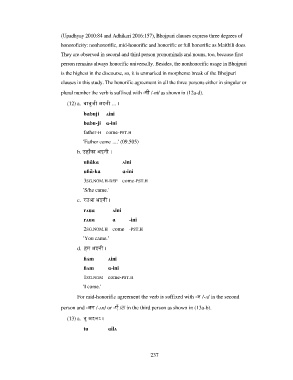
(Upadhyay 2010:84 and Adhikari 2016:157), Bhojpuri clauses express three degrees of
                           honoroficity: nonhonorific, mid-honorific and honorific or full honorific as Maithili does.

                           They are observed in second and third person pronominals and nouns, too, because first
                           person remains always honorific universally. Besides, the nonhonorific usage in Bhojpuri
                           is the highest in the discourse, so, it is unmarked in morpheme break of the Bhojpuri

                           clauses in this study. The honorific agreement in all the three persons either in singular or

                           plural number the verb is suffixed with -नी /-ni/ as shown in (12a-d).
                             (12) a.  बाबुजी अइनी ... ।

                                    bɑbuji   ʌini

                                    bɑbu-ji  ɑ-ini
                                    father-H  come-PST.H
                                    'Father came ....' (09.505)

                                 b. उहाँका अइनी ।

                                    uɦɑ ̃ kɑ        ʌini
                                    uɦɑ ̃ -kɑ       ɑ-ini
                                    3SG.NOM.H-DEF  come-PST.H
                                    'S/he came.'

                                 c.  रउआ अइनी ।

                                    rʌuɑ        ʌini

                                    rʌuɑ        ɑ      -ini
                                    2SG.NOM.H  come  -PST.H

                                    'You came.'
                                 d.  हम अइनी ।

                                    ɦʌm       ʌini
                                    ɦʌm       ɑ-ini

                                    1SG.NOM  come-PST.H
                                    'I came.'

                                 For mid-honorific agreement the verb is suffixed with -अ /-ʌ/ in the second

                           person and -अन /-ʌn/ or -एँ /ẽ/ in the third person as shown in (13a-b).
                             (13) a.  तू अइलऽ ।

                                    tu        ɑilʌ


                                                                237

