


Page 272 - A GRAMMAR OF BHOJPURI _ PhD Dissertation 2020 TU
P. 272
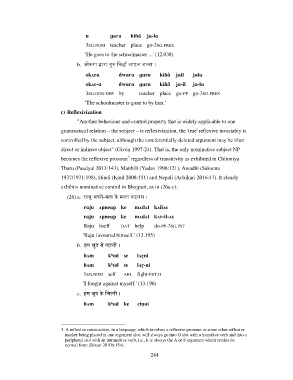
u ɡuru kiɦɑ ̃ jɑ-lɑ
3SG.NOM teacher place go-3SG.PRES
'He goes to the schoolmaster ...' (12.038)
b. ओकरा Gारा गुF .कहाँ जाइल जाला ।
okʌrɑ dwɑrɑ ɡuru kiɦɑ ̃ jɑil jɑlɑ
okʌr-ɑ dwɑrɑ ɡuru kiɦɑ ̃ jɑ-il jɑ-lɑ
3SG.GEN-DEF by teacher place go-PP go-3SG.PRES
'The schoolmaster is gone to by him.'
c) Reflexivization
"Another behaviour-and-control property that is widely applicable to one
grammatical relation the subject is reflexivization, the 'true' reflexive invariably is
controlled by the subject, although the coreferentially-deleted argument may be ither
direct or indirect object" (Givón 1997:24). That is, the only nominative subject NP
3
becomes the reflexive pronoun regardless of transitivity as exhibited in Chitoniya
Tharu (Paudyal 2013:143), Maithili (Yadav 1996:121), Awadhi (Saksena
1937/1971:198), Hindi (Koul 2008:151) and Nepali (Adhikari 2016:47). It clearly
exhibits nominative control in Bhojpuri, as in (26a-c):
(26) a. राजु अपने-आप के मदत कइलस ।
rɑju ʌpneɑp ke mʌdʌt kʌilʌs
rɑju ʌpneɑp ke mʌdʌt kʌr-il-ʌs
Raju itself DAT help do-PP-3SG.PST
'Raju favoured himself.' (13.195)
b. हम खुद से लड़नी ।
ɦʌm kʰud se lʌɽni
ɦʌm kʰud se lʌɽ-ni
1SG.NOM self ABL fight-PST.H
'I fought against myself.' (13.196)
c. हम खुद के िचLनी ।
ɦʌm kʰud ke cin ̥ ni
3. A reflexive construction, in a language, which involves a reflexive pronoun or some other reflexive
marker being placed in one argument slot, will always go into O slot with a transitive verb and into a
peripheral slot with an intransitive verb, i.e., it is always the A or S argument which retains its
normal form (Dixon 2010b:154).
244

