


Page 275 - A GRAMMAR OF BHOJPURI _ PhD Dissertation 2020 TU
P. 275
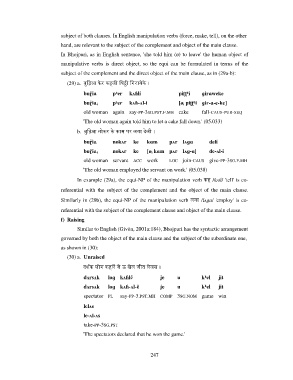
subject of both clauses. In English manipulation verbs (force, make, tell), on the other
                           hand, are relevant to the subject of the complement and object of the main clause.

                           In Bhojpuri, as in English sentence, 'she told him (ø) to leave' the human object of
                           manipulative  verbs  is  direct  object,  so  the  equi  can  be  formulated  in  terms  of  the
                           subject of the complement and the direct object of the main clause, as in (29a-b):

                             (29) a.  बु.ढ़आ फे र कहली िपTी िगरावेके ।

                                    buɽ ̊ iɑ    pʰer   kʌɦli                piʈʈʰi   ɡirɑweke

                                    buɽ ̊ iɑ i   pʰer   kʌɦ-ʌl-i            [ø i piʈʈʰi  ɡir-ɑ-e-ke]
                                    old woman  again  say-PP-3SG.PST.F.MH  cake      fall-CAUS-PUR-SEQ
                                    'The old woman again told him to let a cake fall down.' (05.033)

                                 b.  बु.ढ़आ नोकर के काम पर लगा देली ।
                                    buɽ ̊ iɑ    nokʌr  ke     kɑm       pʌr  lʌɡɑ       deli

                                    buɽ ̊ iɑ i   nokʌr  ke    [ø i kɑm  pʌr  lʌɡ-ɑ]     de-ʌl-i
                                    old woman  servant  ACC  work       LOC  join-CAUS  give-PP-3SG.F.MH

                                    'The old woman employed the servant on work.' (05.038)
                                 In example (29a), the equi-NP of the manipulation verb कह /kʌɦ/ 'tell' is co-

                           referential  with  the  subject  of  the  complement  and  the  object  of  the  main  clause.

                           Similarly in (29b), the equi-NP of the manipulation verb लगा /lʌɡɑ/ 'employ' is co-
                           referential with the subject of the complement clause and object of the main clause.

                           f)  Raising
                                 Similar to English (Givón, 2001a:184), Bhojpuri has the syntactic arrangement

                           governed by both the object of the main clause and the subject of the subordinate one,
                           as shown in (30):
                             (30) a.  Unraised

                                    दशVक लोग कहल; जे ऊ खेल जीत लेलस ।

                                    dʌrsʌk    loɡ  kʌɦlẽ            je     u         kʰel   jit
                                    dʌrsʌk    loɡ  kʌɦ-ʌl-ẽ         je     u         kʰel   jit

                                    spectator  PL   say-PP-3.PST.MH  COMP  3SG.NOM  game  win

                                    lelʌs
                                    le-ʌl-ʌs
                                    take-PP-3SG.PST
                                    'The spectators declared that he won the game.'


                                                                247

