


Page 279 - A GRAMMAR OF BHOJPURI _ PhD Dissertation 2020 TU
P. 279
8.2 Case marking system
                                 Case is a grammatical category to identify the syntactic relationship among

                           words in a sentence. In most cases, case typically marks the relationship of a noun to a
                           verb at the clausal level, or of a noun to a pre/post position before/after another noun
                           at the phrasal level. Simply, the inflection of nouns is called declension and such

                           individual declensions are called cases that together form the case system. In other
                           words, case is actually syntactical relationship of the noun to other verbal elements in

                           the sentences. This section deals with the cases and their marking system.
                                 Typologically, the languages of the world exhibit remarkable diversity in

                           grammatical case marking. Givón (2001a:201-9) observes the three systems so far:
                           active-stative (coding semantic roles), ergative-absolutive (coding transitivity) and

                           nominative-accusative (coding pragmatic function). Bhojpuri employs the
                           pragmatically oriented nominative-accusative case-marking strategy as its close
                           neighbours Chitoniya Tharu (Paudyal 2013:109), Maithili (Yadav 1996:70-1) and

                           Awadhi (Saksena 1937/1971:126) do. In such languages, according to Givón
                           (2001a:203), the case-marking morphology is keyed towards coding the

                           grammaticalized subject (nominative) and direct-object (accusative), regardless of
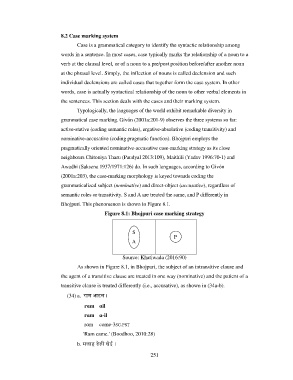
                           semantic roles or transitivity. S and A are treated the same, and P differently in

                           Bhojpuri. This phenomenon is shown in Figure 8.1.
                                             Figure 8.1: Bhojpuri case marking strategy


                                                        S
                                                                          P
                                                        A


                                                    Source: Khatiwada (2016:90)

                                 As shown in Figure 8.1, in Bhojpuri, the subject of an intransitive clause and
                           the agent of a transitive clause are treated in one way (nominative) and the patient of a

                           transitive clause is treated differently (i.e., accusative), as shown in (34a-b).
                             (34) a.  राम आइल ।

                                    rɑm  ɑil

                                    rɑm  ɑ-il
                                    rɑm  come-3SG.PST
                                    'Ram came.' (Boodhoo, 2010:28)

                                 b. मलाह डेङी खेई ।

                                                                251

