


Page 278 - A GRAMMAR OF BHOJPURI _ PhD Dissertation 2020 TU
P. 278
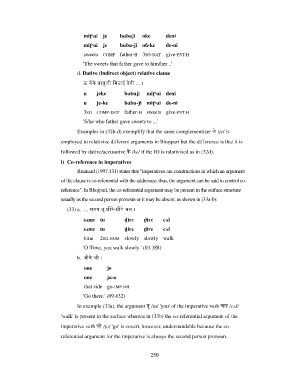
miʈʰɑi  je     bɑbuji    oke      deni
                                    miʈʰɑi  je     bɑbu-ji  oɦ-ke     de-ni

                                    sweets  COMP  father-H  3SG-DAT  give-PST.H
                                    'The sweets that father gave to him/her...'
                                 d. Dative (indirect object) relative clause

                                    ऊ जेके बाबुजी िमठाई देनी ... ।

                                    u    jeke        bɑbuji   miʈʰɑi  deni
                                    u    je-ke       bɑbu-ji  miʈʰɑi  de-ni

                                    3SG  COMP-DAT  father-H  sweets  give-PST.H
                                    'S/he who father gave sweets to ...'

                                 Examples in (32b-d) exemplify that the same complementizer जे /je/ is
                           employed to relativize different arguments in Bhojpuri but the difference is that it is

                           followed by dative/accusative के /ke/ if the IO is ralativised as in (32d).

                           i)  Co-reference in imperatives
                                 Brainard (1997:131) states that "imperatives are constructions in which an argument
                           of the clause is co-referential with the addressee; thus, the argument can be said to control co-

                           reference". In Bhojpuri, the co-referential argument may be present in the surface structure
                           usually as the second person pronoun or it may be absent, as shown in (33a-b):

                             (33) a.  ... समय तू धीरे-धीरे चल ।

                                    sʌmɛ  tu         d ̤ ire   d ̤ ire   cʌl
                                    sʌmɛ  tu         d ̤ ire   d ̤ ire   cʌl

                                    time   2SG.NOM  slowly  slowly  walk
                                    'O Time, you walk slowly.' (03.388)

                                 b.  ओने जो ।
                                    one       jo

                                    one       jɑ-o
                                    that side  go-IMP.NH

                                    'Go there.' (09.432)
                                 In example (33a), the argument तू /tu/ 'you' of the imperative verb चल /cʌl/

                           'walk' is present in the surface whereas in (33b) the co-referential argument of the
                           imperative verb जो /jo/ 'go' is covert, however, understandable because the co-

                           referential argument for the imperative is always the second person pronoun.


                                                                250

