


Page 276 - A GRAMMAR OF BHOJPURI _ PhD Dissertation 2020 TU
P. 276
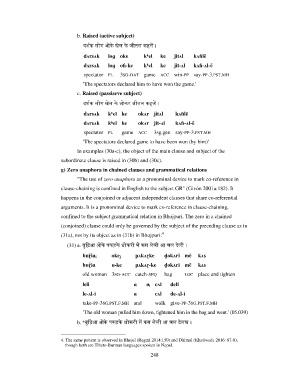
b. Raised (active subject)
                                    दशVक लोग ओके खेल के जीतल कहल; ।

                                    dʌrsʌk    loɡ  oke       kʰel   ke    jitʌl   kʌɦlẽ
                                    dʌrsʌk    loɡ  oɦ-ke     kʰel   ke    jit-ʌl   kʌɦ-ʌl-ẽ

                                    spectator  PL   3SG-DAT  game  ACC  win-PP  say-PP-3.PST.MH
                                    'The spectators declared him to have won the game.'

                                 c. Raised (passiseve subject)
                                    दशVक लोग खेल के ओकर जीतल कहल; ।

                                    dʌrsʌk    kʰel  ke     okʌr  jitʌl    kʌɦlẽ

                                    dʌrsʌk    kʰel  ke     okʌr  jit-ʌl   kʌɦ-ʌl-ẽ
                                    spectator  PL   game  ACC    3sg.gen  say-PP-3.PST.MH
                                    'The spectators declared game to have been won (by him)'

                                 In examples (30a-c), the object of the main clause and subject of the
                           subordinate clause is raised in (30b) and (30c).

                           g) Zero anaphora in chained clauses and grammatical relations
                                 "The use of zero anaphora as a pronominal device to mark co-reference in

                           clause-chaining is confined in English to the subject GR" (Givón 2001a:182). It
                           happens in the conjoined or adjacent independent clauses that share co-referential

                           arguments. It is a pronominal device to mark co-reference in clause-chaining,
                           confined to the subject grammatical relation in Bhojpuri. The zero in a chained
                           (conjoined) clause could only be governed by the subject of the preceding clause as in
                                                                     4
                           (31a), not by its object as in (31b) in Bhojpuri:
                             (31) a. बु.ढ़आ ओके पकड़के धोकरी म; कस लेली आ चल देली ।

                                                          pʌkʌɽke    d ̤ okʌri  mẽ  kʌs
                                    buɽ ̊ iɑ i   oke j
                                    buɽ ̊ iɑ    u-ke      pʌkʌɽ-ke    d ̤ okʌri  mẽ  kʌs

                                    old woman  3SG-ACC  catch-SEQ     bag     LOC  place and tighten

                                    leli                 ɑ    ø i  cʌl   deli
                                    le-ʌl-i              ɑ        cʌl   de-ʌl-i
                                    take-PP-3SG.PST.F.MH  and     walk  give-PP-3SG.PST.F.MH

                                    'The old woman pulled him down, tightened him in the bag and went.' (05.039)

                                 b. *बु.ढ़आ ओके पकड़के धोकरी म; कस लेली आ चल देलख ।


                           4. The same pattern is observed in Bhujel (Regmi 2014:150) and Dhimal (Khatiwada 2016: 87-8),
                            though both are Tibeto-Burman languages spoken in Nepal.
                                                                248

