


Page 281 - A GRAMMAR OF BHOJPURI _ PhD Dissertation 2020 TU
P. 281
Shrivastava (1999:58-65), Sharma and Ashk (2007:47-51), Thakur (2011:61-4) and
                           Singh (2013:86-94); and also discussed here, as shown in (35a-b).

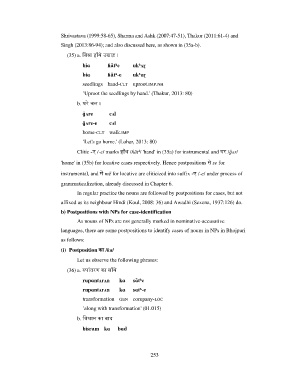
                             (35) a. िबआ हाँथे उखाड़ ।
                                    biɑ       ɦɑ ̃ tʰe     ukʰʌɽ

                                    biɑ       ɦɑ ̃ tʰ-e   ukʰɑɽ
                                    seedlings  hand-CLT  uproot.IMP.NH

                                    'Uproot the seedlings by hand.' (Thakur, 2013: 80)
                                 b. घरे चल ।

                                    ɡ ̈ ʌre     cʌl

                                    ɡ ̈ ʌre-e   cʌl
                                    home-CLT  walk.IMP
                                    'Let's go home.' (Lohar, 2013: 80)

                                 Clitic -ए /-e/ marks हाँथ /ɦɑtʰ/ 'hand' in (35a) for instrumental and घर /ɡ ̈ ʌr/
                                                          ̃
                           'home' in (35b) for locative cases respectively. Hence postpositions से se for

                           instrumental, and म; mẽ for locative are cliticized into suffix -ए /-e/ under process of
                           grammaticalization, already discussed in Chapter 6.

                                 In regular practice the nouns are followed by postpositions for cases, but not
                           affixed as its neighbour Hindi (Koul, 2008: 36) and Awadhi (Sexena, 1937:126) do.

                           b) Postpositions with NPs for case-identification
                                 As nouns of NPs are not generally marked in nominative-accusative

                           languages, there are some postpositions to identify cases of nouns in NPs in Bhojpuri
                           as follows:

                           (i)  Postposition का /kɑ/
                                 Let us observe the following phrases:

                             (36) a. Fपांतरण का साँथे
                                    rupɑntʌrʌn     kɑ    sɑ ̃ tʰe

                                    rupɑntʌrʌn     kɑ    sɑtʰ-e
                                    transformation  GEN  company-LOC

                                    'along with transformation' (01.015)
                                 b. िवYाम का बाद

                                    bisrɑm  kɑ    bɑd


                                                                253

