


Page 282 - A GRAMMAR OF BHOJPURI _ PhD Dissertation 2020 TU
P. 282
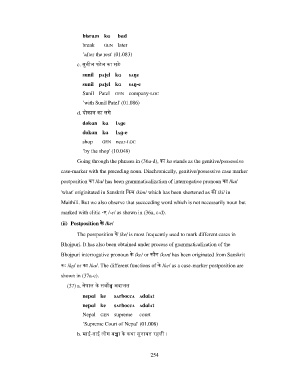
bisrɑm  kɑ    bɑd
                                    break    GEN  later

                                    'after the rest' (01.083)
                                 c. सुनील पटेल का सङे

                                    sunil  pʌʈel  kɑ   sʌŋe
                                    sunil  pʌʈel  kɑ   sʌŋ-e

                                    Sunil  Patel  GEN  company-LOC
                                    'with Sunil Patel' (01.086)

                                 d. दोकान का लगे

                                    dokɑn  kɑ    lʌɡe
                                    dokɑn  kɑ    lʌɡ-e
                                    shop    GEN  near-LOC

                                    'by the shop' (10.048)

                                 Going through the phrases in (36a-d), का kɑ stands as the genitive/possessive
                           case-marker with the preceding noun. Diachronically, genitive/possessive case marker

                           postposition का /kɑ/ has been grammaticalization of interrogative pronoun का /kɑ/

                           'what' originitated in Sanskrit .कम /kim/ which has been shortened as कZ /ki/ in
                           Maithili. But we also observe that succeeding word which is not necessarily noun but

                           marked with clitic -ए /-e/ as shown in (36a, c-d).

                           (ii)  Postposition के /ke/
                                 The postposition के /ke/ is most frequently used to mark different cases in

                           Bhojpuri. It has also been obtained under process of grammaticalization of the

                           Bhojpuri interrogative pronoun के /ke/ or कौन /kɔn/ has been originated from Sanskrit

                           कः /kʌ̤ / or का /kɑ/. The different functions of के /ke/ as a case-marker postposition are
                           shown in (37a-c).

                             (37) a. नेपाल के सव[\ अदालत

                                    nepɑl  ke    sʌrboccʌ  ʌdɑlʌt
                                    nepɑl  ke    sʌrboccʌ  ʌdɑlʌt
                                    Nepal  GEN  supreme    court

                                    'Supreme Court of Nepal' (01.008)
                                 b. माई-दाई लोग ब\ा के कथा सुनावत रहली ।


                                                                254

