


Page 287 - A GRAMMAR OF BHOJPURI _ PhD Dissertation 2020 TU
P. 287
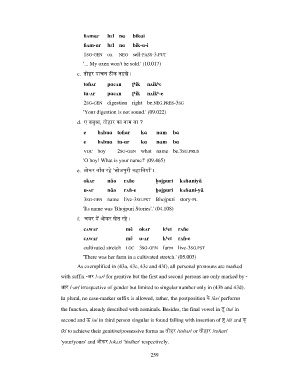
ɦʌmɑr bɛl nɑ bikɑi
ɦʌm-ɑr bɛl nɑ bik-ɑ-i
1SG-GEN ox NEG sell-PASS-3.FUT
'... My oxen won't be sold.' (10.017)
c. तोहर पाचन ठीक नइखे ।
toɦʌr pɑcʌn ʈʰik nʌikʰe
tu-ʌr pɑcʌn ʈʰik nʌikʰ-e
2SG-GEN digestion right be.NEG.PRES-3SG
'Your digestion is not sound.' (09.022)
d. ए बबुआ, तोहार का नाम बा ?
e bʌbuɑ toɦɑr kɑ nɑm bɑ
e bʌbuɑ tu-ɑr kɑ nɑm bɑ
VOC boy 2SG-GEN what name be.3SG.PRES
'O boy! What is your name?' (09.465)
e. ओकर नाँव रहे भोजपुरी कहािनयाँ ।
okʌr nɑ ̃ o rʌɦe b ̤ ojpuri kʌɦɑniyɑ ̃
u-ʌr nɑ ̃ o rʌɦ-e b ̤ ojpuri kʌɦɑni-yɑ ̃
3SG-GEN name live-3SG.PST Bhojpuri story-PL
'Its name was 'Bhojpuri Stories'.' (04.108)
f. चवर म; ओकर खेत रहे ।
cʌwʌr mẽ okʌr kʰet rʌɦe
cʌwʌr mẽ u-ʌr kʰet rʌɦ-e
cultivated stretch LOC 3SG-GEN farm live-3SG.PST
'There was her farm in a cultivated stretch.' (05.003)
As exemplified in (43a, 43c, 43e and 43f), all personal pronouns are marked
with suffix -अर /-ʌr/ for genitive but the first and second persons are only marked by -
आर /-ɑr/ irrespective of gender but limited to singular number only in (43b and 43d).
In plural, no case-marker suffix is allowed, rather, the postposition के /ke/ performs
the function, already described with nominals. Besides, the final vowel in तू /tu/ in
second and ऊ /u/ in third person singular is found falling with insertion of u /ɦ/ and क्
/k/ to achieve their genitive/possessive forms as तोहर /toɦʌr/ or तोहार /toɦɑr/
'your/yours' and ओकर /okʌr/ 'his/her' respectively.
259

