


Page 292 - A GRAMMAR OF BHOJPURI _ PhD Dissertation 2020 TU
P. 292
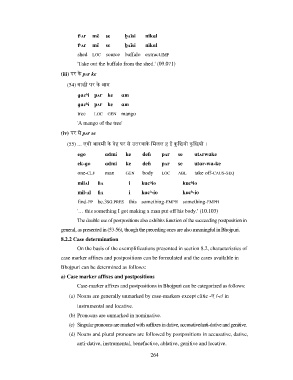
tʰʌr mẽ se b ̤ ʌĩsi nikɑl
tʰʌr mẽ se b ̤ ʌĩsi nikɑl
shed LOC source buffalo extract.IMP
'Take out the buffalo from the shed.' (09.071)
(iii) पर के pʌr ke
(54) गाछी पर के आम
ɡɑcʰi pʌr ke ɑm
ɡɑcʰi pʌr ke ɑm
tree LOC GEN mango
'A mango of the tree'
(iv) पर से pʌr se
(55) ... एगो आदमी के देह पर से उतरवाके िमलल ह ई कुिछयो कुिछयो ।
eɡo ɑdmi ke deɦ pʌr se utʌrwɑke
ek-ɡo ɑdmi ke deɦ pʌr se utɑr-wɑ-ke
one-CLF man GEN body LOC ABL take off-CAUS-SEQ
milʌl ɦʌ i kucʰio kucʰio
mil-ʌl ɦʌ i kucʰ-io kucʰ-io
find-PP be.3SG.PRES this something-EMPH something-EMPH
'
this something I got making a man put off his body.' (10.103)
The double use of postpositions also exhibits function of the succeeding postposition in
general, as presented in (53-56), though the preceding ones are also meaningful in Bhojpuri.
8.2.2 Case determination
On the basis of the exemplifications presented in section 8.2, characteristics of
case marker affixes and postpositions can be formulated and the cases available in
Bhojpuri can be determined as follows:
a) Case marker affixes and postpositions
Case-marker affixes and postpositions in Bhojpuri can be categorized as follows:
(a) Nouns are generally unmarked by case-markers except clitic -ए /-e/ in
instrumental and locative.
(b) Pronouns are unmarked in nominative.
(c) Singular pronouns are marked with suffixes in dative, accusative/anti-dative and genitive.
(d) Nouns and plural pronouns are followed by postpositions in accusative, dative,
anti-dative, instrumental, benefactive, ablative, genitive and locative.
264

