


Page 295 - A GRAMMAR OF BHOJPURI _ PhD Dissertation 2020 TU
P. 295
CHAPTER 9
                                              NOUN PHRASES AND WORD ORDER

                           9.0  Outline
                                 This chapter deals with noun phrases and word order in Bhojpuri. It consists of
                           three sections. In section 9.1 we describe noun phrases and word order is described in

                           section 9.2. Lastly, in section 9.3 we summarize the findings.

                           9.1 Noun phrases
                                 Noun phrase may be characterized as the syntactic constituent that serve as
                                            1
                           arguments of verbs.  In accordance with the typological make up of South Asian
                           languages, Bhojpuri has head-final phrasal structures (Verma 2003:527). A noun
                           phrase may take up a syntactic position where a noun or a pronoun can occupy. In this

                           sub-section, we deal with the types of noun phrases, elements of noun phrases, linear
                           order of constituents in noun phrase and dispersed/scattered NPs in Bhojpuri.
                           In this section we deal with the structure and major functions of the noun phrase in

                           Bhojpuri.
                           9.1.1 Simplex noun phrases

                                 As displayed in Chitoniya Tharu (Paudyal 2013:285-90), Maithili (Yadav 1996:96-
                           102), Hindi (Koul 2008:165-71) and Nepali (Adhikari 2016:314-5), the noun phrases in

                           Bhojpuri range from a single word (referential noun or personal pronoun) to syntactically
                           complex noun phrases (conjoined nouns and relative clauses and nominalized clauses). A

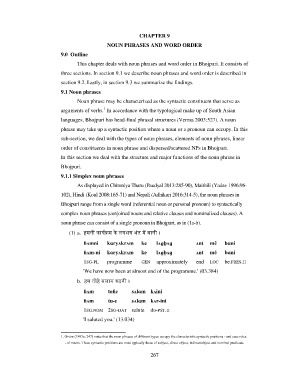
                           noun phrase can consist of a single pronoun in Bhojpuri, as in (1a-b).
                              (1) a.  हमनी काय)*म के लगभग अंत म2 बानी ।

                                    ɦʌmni     kɑryʌkrʌm     ke    lʌɡb ̤ ʌɡ        ʌnt  mẽ     bɑni
                                    ɦʌm-ni    kɑryʌkrʌm     ke    lʌɡb̤ ʌɡ         ʌnt  mẽ     bɑni

                                    1SG-PL    programme     GEN  approximately     end   LOC  be.PRES.H
                                    'We have now been at almost end of the programme.' (03.384)

                                 b.  हम तोहे सलाम कइनी ।
                                    ɦʌm       toɦe      sʌlɑm  kʌini

                                    ɦʌm       tu-e      sʌlɑm  kʌr-ini
                                    1SG.NOM  2SG-DAT  salute  do-PST.H

                                    'I saluted you.' (13.034)


                           1. Givón (1993a: 247) notes that the noun phrases of different types occupy the characteristic syntactic positions - and case roles
                            - of nouns. These syntactic positions are most typically those of subject, direct object, indirect object and nominal predicate.

                                                                267

