


Page 300 - A GRAMMAR OF BHOJPURI _ PhD Dissertation 2020 TU
P. 300
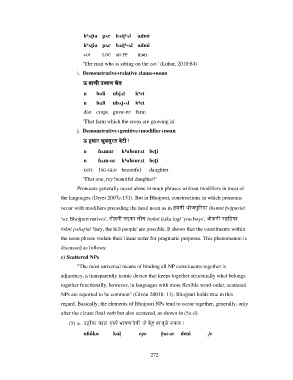
kʰʌʈiɑ  pʌr  bʌiʈʰʌl  ɑdmi
                                    kʰʌʈiɑ  pʌr  bʌiʈʰ-ʌl  ɑdmi

                                    cot     LOC  sit-PP    man
                                    'The man who is sitting on the cot.' (Lohar, 2010:84)
                                 i.  Demonstrative+relative clause+noun

                                    ऊ बाली उ'जल खेत

                                    u    bɑli   ubjʌl     kʰet
                                    u    bɑli   ubʌj-ʌl  kʰet

                                    dist  crops  grow-PP  farm
                                    'That farm which the crops are growing in'

                                 j.  Demonstrative+genitive+modifier+noun
                                    ऊ हमार खुबसुरत बेटी !

                                    u     ɦʌmɑr     kʰubsurʌt  beʈi
                                    u     ɦʌm-ɑr  kʰubsurʌt  beʈi

                                    DIST  1SG-GEN  beautiful   daughter
                                    'That one, my beautiful daughter!'

                                 Pronouns generally occur alone in noun phrases without modifiers in most of
                           the languages (Dryer 2007c:151). But in Bhojpuri, constructions in which pronouns

                           occur with modifiers preceding the head noun as in हमनी भोजपुGरया /ɦʌmni b ̤ ojpuriɑ/
                           'we Bhojpuri natives', तोहनी लइका लोग /toɦni lʌikɑ loɡ/ 'you boys', ओकनी पहिड़या

                           /okni pʌɦʌɽiɑ/ 'they, the hill people' are possible. It shows that the constituents within

                           the noun phrase violate their linear order for pragmatic purposes. This phenomenon is
                           discussed as follows:
                           c) Scattered NPs

                                 "The most universal means of binding all NP constituents together is
                           adjacency, a transparently iconic device that keeps together structurally what belongs

                           together functionally, however, in languages with more flexible word-order, scattered
                           NPs are reported to be common" (Givόn 2001b: 13). Bhojpuri holds true in this

                           regard. Basically, the elements of Bhojpuri NPs tend to occur together, generally, only
                           after the clause final verb but also scattered, as shown in (5a-d).

                              (5) a.  उहाँका काO एगो भाषण देनी जे के/ ना बुझे सकल ।
                                    uɦɑ ̃ kɑ    kɑl̥       eɡo      b ̤ ɑsʌn  deni      je


                                                                272

