


Page 291 - A GRAMMAR OF BHOJPURI _ PhD Dissertation 2020 TU
P. 291
ɦʌm-ni  ke     kʰeti    kisɑni     ke   kɑm  bʌɦut  duruɦ       ɦo
                                    1SG-PL   GEN  farming  peasantry  GEN  work  very      difficult  be

                                    ɡʌil   bɑʈe
                                    jɑ-il   bɑ

                                    go-PP  be.3SG.PRES
                                    'Our farming activities have worsened to the most difficult ones.' (02.009)

                                 b.  ... आउर .दन भी अपने लोग से बात करेम ।
                                    ɑur      din  b ̤ i   ʌpne  loɡ  se   bɑt     kʌrem

                                    ɑur      din  b ̤ i   ʌpne  loɡ  se   bɑt     kʌr-em
                                    coming  day  also  2SG.H  PL    with  matter  do-FUT.H

                                    'I will talk to you on the coming days, too.' (02.135)
                                 c.  ओ लोग के _यास खाितर हम ध|यवाद देवेके चाहेम ।

                                    o    loɡ  ke    prʌyɑs  kʰɑtir  ɦʌm        d ̤ ʌnyʌbɑd

                                    u    loɡ  ke    prʌyɑs  kʰɑtir  ɦʌm        d ̤ ʌnyʌbɑd
                                    3SG  PL   GEN  effort    for     1SG.NOM  thank

                                    deweke        cɑɦem
                                    de-e-ke       cɑɦ-em
                                    give-PUR-SEQ  want-FUT.H

                                    'I want to thank for their efforts.' (03.137)
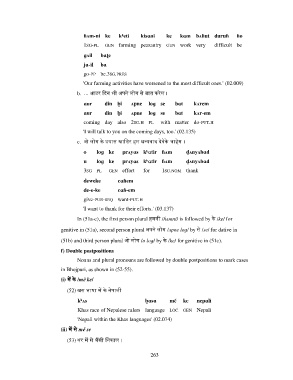
                                 In (51a-c), the first person plural हमनी /ɦʌmni/ is followed by के /ke/ for

                           genitive in (51a), second person plural अपने लोग /ʌpne loɡ/ by से /se/ for dative in

                           (51b) and third person plural ओ लोग /o loɡ/ by के /ke/ for genitive in (51c).

                           f) Double postpositions
                                 Nouns and plural pronouns are followed by double postpositions to mark cases

                           in Bhojpuri, as shown in (52-55).
                          (i) म+ के /mẽ ke/

                             (52) खस भाषा म; के नेपाली

                                 kʰʌs                         b ̤ ɑsɑ   mẽ  ke     nepɑli
                                 Khas race of Nepalese rulers  language  LOC  GEN  Nepali

                                 'Nepali within the Khas languages' (02.074)
                          (ii)  म+ से mẽ se

                             (53) थर म; से भ}सी िनकाल ।


                                                                263

