


Page 290 - A GRAMMAR OF BHOJPURI _ PhD Dissertation 2020 TU
P. 290
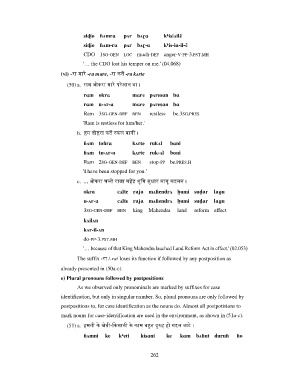
siɖio ɦʌmrɑ pʌr bʌɽɑ kʰisiʌilẽ
siɖio ɦʌm-rɑ pʌr bʌɽ-ɑ kʰis-iɑ-il-ẽ
CDO 1SG-GEN LOC much-DEF anger-V-PP-3.PST.MH
'
the CDO lost his temper on me.' (04.068)
(vi) -रा मारे -rɑ mɑre, -रा कत. -rɑ kʌrte
(50) a. राम ओकरा मारे परेशान बा ।
rɑm okrɑ mɑre pʌresɑn bɑ
rɑm u-ʌr-ɑ mɑre pʌresɑn bɑ
Ram 3SG-GEN-DEF BEN restless be.3SG.PRES
'Ram is restless for him/her.'
b. हम तोहरा कतn Fकल बानी ।
ɦʌm toɦrɑ kʌrte rukʌl bɑni
ɦʌm tu-ʌr-ɑ kʌrte ruk-ʌl bɑni
Ram 2SG-GEN-DEF BEN stop-PP be.PRES.H
'I have been stopped for you.'
c. ... ओकरा चlते राजा मह;x भूिम सुधार लागू कइलन ।
okrɑ cʌlte rɑjɑ mʌɦendrʌ b ̤ umi sud ̤ ɑr lɑɡu
u-ʌr-ɑ cʌlte rɑjɑ mʌɦendrʌ b ̤ umi sud ̤ ɑr lɑɡu
3SG-GEN-DEF BEN king Mahendra land reform effect
kʌilʌn
kʌr-il-ʌn
do-PP-3.PST.MH
'
because of that King Mahendra lauched Land Reform Act in effect.' (02.053)
The suffix -रा /-rɑ/ loses its function if followed by any postposition as
already presented in (50a-c).
e) Plural pronouns followed by postpositions
As we observed only pronominals are marked by suffixes for case
identification, but only in singular number. So, plural pronouns are only followed by
postpositions to, for case identification as the nouns do. Almost all postpotisions to
mark nouns for case-identification are used in the environment, as shown in (51a-c).
(51) a. हमनी के खेती-.कसानी के काम ब{त दुFह हो गइल बाटे ।
ɦʌmni ke kʰeti kisɑni ke kɑm bʌɦut duruɦ ɦo
262

