


Page 280 - A GRAMMAR OF BHOJPURI _ PhD Dissertation 2020 TU
P. 280
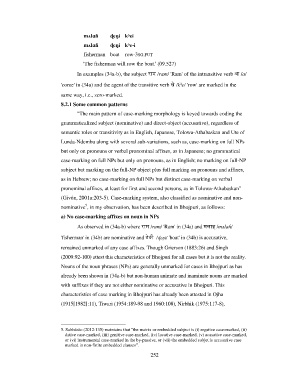
mʌlɑɦ ɖeŋi kʰei
mʌlɑɦ ɖeŋi kʰe-i
fisherman boat row-3SG.FUT
'The fisherman will row the boat.' (09.527)
In examples (34a-b), the subject राम /rɑm/ 'Ram' of the intransitive verb आ /ɑ/
'come' in (34a) and the agent of the transitive verb खे /kʰe/ 'row' are marked in the
same way, i.e., zero-marked.
8.2.1 Some common patterns
"The main pattern of case-marking morphology is keyed towards coding the
grammaticalized subject (nominative) and direct-object (accusative), regardless of
semantic roles or transitivity as in English, Japanese, Tolowa-Athabaskan and Ute of
Lunda-Ndembu along with several sub-variations, such as, case-marking on full NPs
but only on pronouns or verbal pronominal affixes, as in Japanese; no grammatical
case-marking on full NPs but only on pronouns, as in English; no marking on full-NP
subject but marking on the full-NP object plus full marking on pronouns and affixes,
as in Hebrew; no case-marking on full NPs but distinct case-marking on verbal
pronominal affixes, at least for first and second persons, as in Tolowa-Athabaskan"
(Givón, 2001a:203-5). Case-marking system, also classified as nominative and non-
5
nominative , in my observation, has been described in Bhojpuri, as follows:
a) No case-marking affixes on noun in NPs
As observed in (34a-b) where राम /rɑm/ 'Ram' in (34a) and मलाह /mʌlɑɦ/
'fisherman' in (34b) are nominative and डेङी /ɖeŋi/ 'boat' in (34b) is accusative,
remained unmarked of any case affixes. Though Grierson (1883:26) and Singh
(2009:92-100) attest this characteristics of Bhojpuri for all cases but it is not the reality.
Nouns of the noun phrases (NPs) are generally unmarked for cases in Bhojpuri as has
already been shown in (34a-b) but non-human animate and inaminate nouns are marked
with suffixes if they are not either nominative or accusative in Bhojpuri. This
characteristics of case marking in Bhojpuri has already been attested in Ojha
(1915[1982]:11), Tiwari (1954:189-98 and 1960:108), Nirbhik (1975:117-8),
5. Subbārāo (2012:135) maintains that "the matrix or embedded subject is (i) ergative case-marked, (ii)
dative case-marked, (iii) genitive case-marked, (iv) locative case-marked, (v) acusative case-marked,
or (vi) instrumental case-marked in the by-passive, or (vii) the embedded subjet is accusative case
marked in non-finite embedded clauses.
252

