


Page 247 - A GRAMMAR OF BHOJPURI _ PhD Dissertation 2020 TU
P. 247
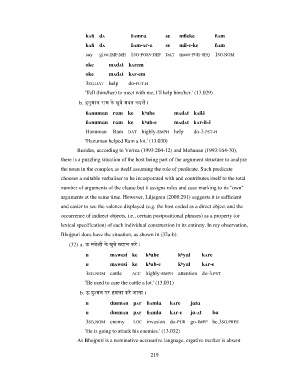
kʌɦ  dʌ            ɦʌmrɑ         se    mileke        ɦʌm
                                     kʌɦ  dʌ            ɦʌm-ʌr-ɑ      se    mil-e-ke       ɦʌm

                                     say  give.IMP.MH  1SG-POSS-DEF  DAT  meet-PUR-SEQ  1SG.NOM

                                     oke       mʌdʌt  kʌrem
                                     oke       mʌdʌt  kʌr-em
                                     3SG.DAT  help     do-FUT.H

                                     'Tell (him/her) to meet with me, I'll help him/her.' (13.029)
                                  b. हनुमान राम के खुबे मदत कइलB ।


                                     ɦʌnumɑn  rɑm  ke       kʰube         mʌdʌt  kʌilẽ
                                     ɦʌnumɑn  rɑm  ke       kʰub-e        mʌdʌt  kʌr-il-ẽ

                                     Hanuman  Ram  DAT  highly-EMPH  help         do-3.PST-H
                                     'Hanuman helped Ram a lot.' (13.030)


                                 Besides, according to Verma (1993:204-12) and Mohanan (1993:164-70),
                           there is a puzzling situation of the host being part of the argument structure to analyze

                           the noun in the complex as itself assuming the role of predicate. Such predicate
                           chooses a suitable verbaliser to be incorporated with and contributes itself to the total
                           number of arguments of the clause but it assigns roles and case marking to its "own"

                           arguments at the same time. However, Liljegren (2008:291) suggests it is sufficient
                           and easier to see the valence displayed (e.g. the host coded as a direct object and the

                           occurrence of indirect objects, i.e., certain postpositional phrases) as a property (or
                           lexical specification) of each individual construction in its entirety. In my observation,
                           Bhojpuri does have the situation, as shown in (32a-b).

                              (32) a. ऊ मवेशी के खुबे oयाल करे ।

                                     u         mʌwesi  ke     kʰube        kʰyɑl     kʌre
                                     u         mʌwesi  ke     kʰub-e       kʰyɑl     kʌr-e

                                     3SG.NOM  cattle    ACC  highly-EMPH  attention  do-3.PST
                                     'He used to care the cattle a lot.' (13.031)

                                   b. ऊ दुpमन पर हमला करे जाता ।
                                     u         dusmʌn  pʌr  ɦʌmlɑ       kʌre     jɑtɑ

                                     u         dusmʌn  pʌr  ɦʌmlɑ       kʌr-e    jɑ-ʌt    bɑ
                                     3SG.NOM  enemy      LOC  invasion  do-PUR  go-IMPF  be.3SG.PRES

                                     'He is going to attack his enemies.' (13.032)
                                 As Bhojpuri is a nominative-accusative language, ergative marker is absent


                                                                219

