


Page 242 - A GRAMMAR OF BHOJPURI _ PhD Dissertation 2020 TU
P. 242
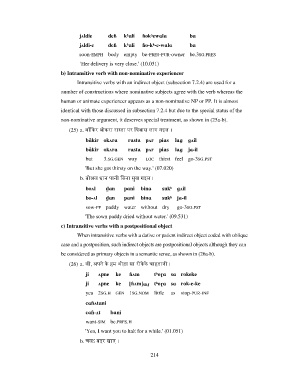
jʌldie      deɦ    kʰɑli   ɦokʰewɑlɑ          bɑ
                                  jʌldi-e     deɦ    kʰɑli   ɦo-kʰ-e-wɑlɑ       bɑ

                                  soon-EMPH  body  empty  be-PRES-PUR-owner  be.3SG.PRES
                                   'Her delivery is very close.' (10.031)

                           b) Intransitive verb with non-nominative experiencer
                                 Intransitive verbs with an indirect object (subsection 7.2.4) are used for a
                           number of constructions where nominative subjects agree with the verb whereas the

                           human or animate experiencer appears as a non-nominative NP or PP. It is almost
                           identical with those discussed in subsection 7.2.4 but due to the special status of the
                           non-nominative argument, it deserves special treatment, as shown in (25a-b).

                              (25) a. बाँFकर ओकरा रा1ता पर िपआस लाग गइल ।

                                     bɑ ̃ kir  okʌrɑ   rɑstɑ  pʌr  piɑs  lɑɡ  ɡʌil
                                     bɑ ̃ kir  okʌrɑ   rɑstɑ  pʌr  piɑs  lɑɡ  jɑ-il

                                     but    3.SG.GEN  way     LOC  thirst  feel  go-3SG.PST
                                     'But she got thirsty on the way.' (07.020)

                                   b. बोअल धान पानी िबना सुख गइल ।

                                     boʌl    d ̤ ɑn   pɑni  binɑ     sukʰ  ɡʌil
                                     bo-ʌl   d ̤ ɑn   pɑni  binɑ     sukʰ  jɑ-il

                                     sow-PP  paddy  water  without  dry    go-3SG.PST
                                     'The sown paddy dried without water.' (09.531)
                           c) Intransitive verbs with a postpositional object

                                 When intransitive verbs with a dative or patient indirect object coded with oblique
                           case and a postposition, such indirect objects are postpositional objects although they can

                           be considered as primary objects in a semantic sense, as shown in (26a-b).
                              (26) a. जी, अपने के हम थोड़ा सा रोकेके चाहतानी ।

                                     ji   ʌpne  ke     ɦʌm       tʰoɽɑ  sɑ  rokeke
                                     ji   ʌpne  ke     [ɦʌm] SBJ  tʰoɽɑ  sɑ  rok-e-ke

                                     yea  2SG.H  GEN  1SG.NOM  little   as  stop-PUR-INF

                                     cɑɦʌtɑni
                                     cɑɦ-ʌt    bɑni
                                     want-SIM  be.PRES.H

                                     'Yea, I want you to halt for a while.' (01.051)
                                   b. चलऽ बइर खाए ।


                                                                214

