


Page 240 - A GRAMMAR OF BHOJPURI _ PhD Dissertation 2020 TU
P. 240
7.2.6 Bi-transitive verbs
Bi-transitive verbs have the indirect object but human goal with a benefactive
role instead of being a locational one:
दे /de/ 'give' ले /le/ 'bring, take'
भेज /b ̤ ej/ 'send' िलख /likʰ/ 'write'
पढ़ा /pʌɽ ̊ ɑ/ 'teach' देखा /dekʰɑ/ 'show'
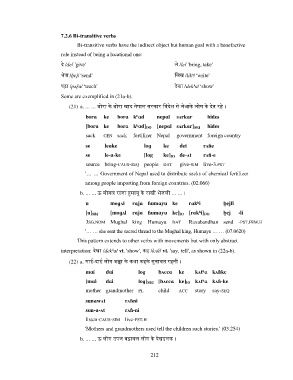
Some are exemplified in (21a-b).
(21) a. ... ... बोरा के बोरा खाद नेपाल सरकार िवदेश से लेआके लोग के देत रहे ।
borɑ ke borɑ kʰɑd nepɑl sʌrkɑr bides
[borɑ ke borɑ kʰɑd] DO [nepɑl sʌrkɑr] SBJ bides
sack GEN sack fertilizer Nepal government foreign country
se leɑke loɡ ke det rʌɦe
se le-ɑ-ke [log ke] IO de-ʌt rʌɦ-e
source bring-CAUS-SEQ people DAT give-SIM live-3.PST
'
Government of Nepal used to distribute sacks of chemical fertilizer
among people importing from foreign countries. (02.066)
b. ... ... ऊ मोगल राजा [मायू के राखी भेजली ... ... ।
u moɡʌl rɑjɑ ɦumɑyu ke rɑkʰi b ̤ ejli
[u] SBJ [moɡʌl rɑjɑ ɦumɑyu ke] IO [rɑkʰi] DO b ̤ ej -li
3SG.NOM Mughal king Humayu DAT Raxabandhan send -PST.FEM.H
'
she sent the sacred thread to the Mughal king, Humayu
(07.0620)
This pattern extends to other verbs with movements but with only abstract
interpretation: देखा /dekʰɑ/ vt. 'show', कह /kʌɦ/ vt. 'say, tell', as shown in (22a-b).
(22) a. माई-दाई लोग बgा के कथा कहके सुनावत रहनी ।
mɑi dɑi loɡ bʌccɑ ke kʌtʰɑ kʌɦke
[mɑi dɑi loɡ] SBJ [bʌccɑ ke] IO kʌtʰɑ kʌɦ-ke
mother grandmother PL child ACC story say-SEQ
sunɑwʌt rʌɦni
sun-ɑ-ʌt rʌɦ-ni
listen-CAUS-SIM live-PST.H
'Mothers and grandmothers used tell the children such stories.' (03.254)
b. ... ... ऊ लोग उपज बढ़ावल लोग के देखइलक ।
212

