


Page 245 - A GRAMMAR OF BHOJPURI _ PhD Dissertation 2020 TU
P. 245
a) Conjunct verbs with कर /kʌr/ 'do'
Formation of conjunct verbs with verbalizer कर /kʌr/ 'do' is the most
productive and a wide variety of constructions and possible argument structures
formed this way are noticed accordingly. To some extent, the host may be loaned
from another language. All of such constructions are transitive. According to Verma
(1993:201), conjunct verbs are subclassified into three types lexically complex,
syntactically complex and a purely analytical sequence superficially looking like a
conjunct verb. Such conjuncts can be distinguished into internal agreement conjuncts
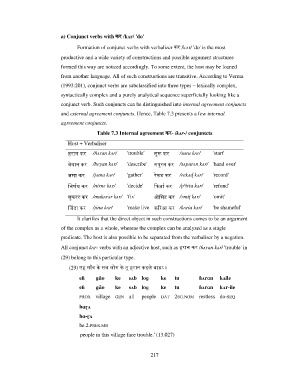
and external agreement conjuncts. Hence, Table 7.3 presents a few internal
agreement conjuncts.
Table 7.3 Internal agreement कर- /kʌr-/ conjuntcts
Host + Verbaliser
हरान कर /ɦʌrɑn kʌr/ 'trouble' सुV कर /suru kʌr/ 'start'
बेयान कर /beyɑn kʌr/ 'describe' सपुरन कर /sʌpurʌn kʌr/ 'hand over'
जमा कर /jʌmɑ kʌr/ 'gather' रेकड कर /rekʌɖ kʌr/ 'record'
िनण_य कर /nirnɛ kʌr/ 'decide' Fफता_ कर /pʰirtɑ kʌr/ 'refund'
मुकरर कर /mukʌrʌr kʌr/ 'fix' ओिमट कर /ɔmiʈ kʌr/ 'omit'
nजदा कर /jinɑ kʌr/ 'make live कTरआ कर /kʌriɑ kʌr/ 'be shameful'
It clarifies that the direct object in such constructions comes to be an argument
of the complex as a whole, whereas the complex can be analyzed as a single
predicate. The host is also possible to be separated from the verbaliser by a negation.
All conjunct kʌr- verbs with an adjective host, such as हरान कर /ɦʌrɑn kʌr/ 'trouble' in
(29) belong to this particular type.
(29) एह गाँव के सब लोग के तू हरान कइले बाड़ऽ ।
eɦ ɡɑ ̃ o ke sʌb loɡ ke tu ɦʌrɑn kʌile
eɦ ɡɑ ̃ o ke sʌb loɡ ke tu ɦʌrɑn kʌr-ile
PROX village GEN all people DAT 2SG.NOM restless do-SEQ
bɑɽʌ
bɑ-ɽʌ
be.2.PRES.MH
people in this village face trouble.' (13.027)
217

