


Page 244 - A GRAMMAR OF BHOJPURI _ PhD Dissertation 2020 TU
P. 244
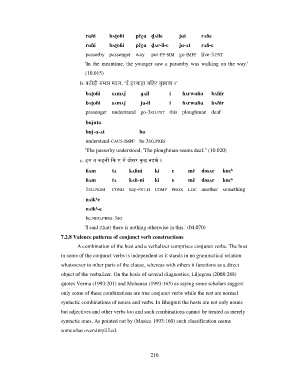
rɑɦi bʌʈoɦi pɛ ̃ ɽɑ d ̤ ʌile jɑt rʌɦe
rɑɦi bʌʈoɦi pɛ ̃ ɽɑ d ̤ ʌr-il-e jɑ-ʌt rʌɦ-e
passerby passenger way put-PP-SIM go-IMPF live-3.PST
'In the meantime, the younger saw a passerby was walking on the way.'
(10.015)
b. बटोही समझ गइल, ई हरवाहा बिहर बुझाता ।
bʌʈoɦi sʌmʌȷ ̈ ɡʌil i ɦʌrwɑɦɑ bʌɦir
bʌʈoɦi sʌmʌȷ ̈ jɑ-il i ɦʌrwɑɦɑ bʌɦir
passenger understand go-3SG.PST this ploughman deaf
buȷ ̈ ɑtɑ
buȷ ̈ -ɑ-ʌt bɑ
understand-CAUS-IMPF be.3SG.PRES
'The passerby understood, 'The ploughman seems deaf.'' (10.020)
c. हम त कहनी Fक ए मB दोसर कुछ नइखे ।
ɦʌm tʌ kʌɦni ki e mẽ dosʌr kucʰ
ɦʌm tʌ kʌɦ-ni ki e mẽ dosʌr kucʰ
1SG.NOM COND say-PST.H COMP PROX LOC another something
nʌikʰe
nʌikʰ-e
be.NEG.PRES-3SG
'I said (that) there is nothing otherwise in this.' (04.070)
7.2.8 Valence patterns of conjunct verb constructions
A combination of the host and a verbalizer comprises conjunct verbs. The host
in some of the conjunct verbs is independent as it stands in no grammatical relation
whatsoever to other parts of the clause, whereas with others it functions as a direct
object of the verbalizer. On the basis of several diagnostics, Liljegren (2008:288)
quotes Verma (1993:201) and Mohanan (1993:165) as saying some scholars suggest
only some of these combinations are true conjunct verbs while the rest are normal
syntactic combinations of nouns and verbs. In Bhojpuri the hosts are not only nouns
but adjectives and other verbs too and such combinations cannot be treated as merely
syntactic ones. As pointed out by (Masica 1993:160) such classification seems
somewhat oversimplified.
216

