


Page 246 - A GRAMMAR OF BHOJPURI _ PhD Dissertation 2020 TU
P. 246
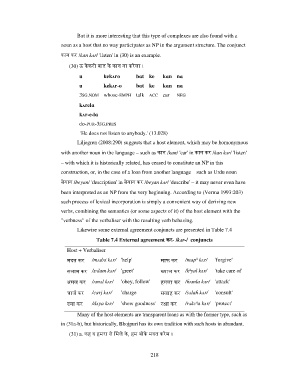
But it is more interesting that this type of complexes are also found with a
noun as a host that no way participates as NP in the argument structure. The conjunct
कान कर /kɑn kʌr/ 'listen' in (30) is an example.
(30) ऊ केकरो बात के कान ना करेला ।
u kekʌro bɑt ke kɑn nɑ
u kekʌr-o bɑt ke kɑn nɑ
3SG.NOM whose-EMPH talk ACC ear NEG
kʌrelɑ
kʌr-e-lɑ
do-PUR-3SG.PRES
'He does not listen to anybody.' (13.028)
Liljegren (2008:290) suggests that a host element, which may be homonymous
with another noun in the language such as कान /kɑn/ 'ear' in कान कर /kɑn kʌr/ 'listen'
with which it is historically related, has ceased to constitute an NP in this
construction, or, in the case of a loan from another language such as Urdu noun
बेयान /beyɑn/ 'description' in बेयान कर /beyɑn kʌr/ 'describe' it may never even have
been interpreted as an NP from the very beginning. According to (Verma 1993:203)
such process of lexical incorporation is simply a convenient way of deriving new
verbs, combining the semantics (or some aspects of it) of the host element with the
"verbness" of the verbaliser with the resulting verb behaving.
Likewise some external agreement conjuncts are presented in Table 7.4
Table 7.4 External agreement कर- /kʌr-/ conjuncts
Host + Verbaliser
मदत कर /mʌdʌt kʌr/ 'help' माफ कर /mɑpʰ kʌr/ 'forgive'
सलाम कर /sʌlɑm kʌr/ 'greet' oयाल कर /kʰyɑl kʌr/ 'take care of'
अमल कर /ʌmʌl kʌr/ 'obey, follow' हमला कर /ɦʌmlɑ kʌr/ 'attack'
चाज_ कर /cɑrj kʌr/ 'charge सलाह कर /sʌlɑɦ kʌr/ 'consult'
दया कर /dʌya kʌr/ 'show goodness' र"ा कर /rʌkcʰɑ kʌr/ 'protect'
Many of the host elements are transparent loans as with the former type, such as
in (31a-b), but historically, Bhojpuri has its own tradition with such hosts in abundant.
(31) a. कह द हमरा से िमले के, हम ओके मदत करेम ।
218

