


Page 238 - A GRAMMAR OF BHOJPURI _ PhD Dissertation 2020 TU
P. 238
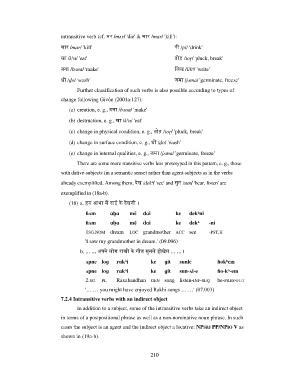
intransitive verb (cf. मर /mʌr/ 'die' & मार /mɑr/ 'kill'):
मार /mɑr/ 'kill' पी /pi/ 'drink'
खा /kʰɑ/ 'eat' तोड़ /toɽ/ 'pluck, break'
बना /bʌnɑ/ 'make' िलख /likʰ/ 'write'
धो /d ̤ o/ 'wash' जमा /jʌmɑ/ 'germinate, freeze'
Further classification of such verbs is also possible according to types of
change following Givón (2001a:127):
(a) creation, e. g., बना /bʌnɑ/ 'make'
(b) destruction, e. g., खा /kʰɑ/ 'eat'
(c) change in physical condition, e. g., तोड़ /toɽ/ 'pluck, break'
(d) change in surface condition, e. g., धो /d ̤ o/ 'wash'
(e) change in internal qualities, e. g., जमा /jʌmɑ/ 'germinate, freeze'
There are some more transitive verbs less prototyped in this pattern, e. g., those
with dative-subjects (in a semantic sense) rather than agent-subjects as in the verbs
already exemplified. Among them, देख /dekʰ/ 'see' and सुन /sun/ 'hear, listen' are
exemplified in (18a-b).
(18) a. हम आभा मB दाई के देखनी ।
ɦʌm ɑb ̤ ɑ mẽ dɑi ke dekʰni
ɦʌm ɑb̤ ɑ mẽ dɑi ke dekʰ -ni
1SG.NOM dream LOC grandmother ACC see -PST.H
'I saw my grandmother in dream.' (09.096)
b. ... ... अपने लोग राखी के गीत सुनले होखेम ... ... ।
ʌpne loɡ rɑkʰi ke ɡit sunle ɦokʰem
ʌpne loɡ rɑkʰi ke ɡit sun-ʌl-e ɦo-kʰ-em
2.SG PL Raxabandhan GEN song listen-INF-SEQ be-PRES-FUT
'
you might have enjoyed Rakhi songs
' (07.003)
7.2.4 Intransitive verbs with an indirect object
In addition to a subject, some of the intransitive verbs take an indirect object
in terms of a postpositional phrase as well as a non-nominative noun phrase. In such
cases the subject is an agent and the indirect object a locative: NPSBJ PP/NPIO V as
shown in (19a-b).
210

