Page 236 - A GRAMMAR OF BHOJPURI _ PhD Dissertation 2020 TU
P. 236
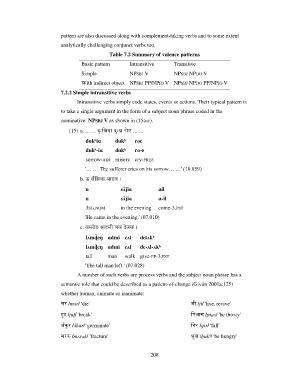
pattern are also discussed along with complement-taking verbs and to some extent
                           analytically challenging conjunct verbs too.

                                               Table 7.2 Summary of valence patterns
                                   Basic pattern       Intransitive       Transitive

                                   Simple              NPSBJ V            NPSBJ NPDO V
                                   With indirect object  NPSBJ PP/NPIO V  NPSBJ NPDO PP/NPIO V

                           7.2.2 Simple intransitive verbs
                                 Intransitive verbs simply code states, events or actions. Their typical pattern is
                           to take a single argument in the form of a subject noun phrase coded in the

                           nominative: NPSBJ V as shown in (15a-c).

                              (15) a. ... ... दुःिखया दुःख रोए ... ...
                                     dukʰiɑ      dukʰ    roe

                                     dukʰ-iɑ     dukʰ    ro-e
                                     sorrow-ADJ  misery  cry-PRES

                                     '… … The sufferer cries on his sorrow… …' (10.059)
                                   b. ऊ सँिझया आइल ।

                                     u             sʌ ̃ ȷ ̈ iɑ     ɑil
                                     u             sʌ ̃ ȷ ̈ iɑ     ɑ-il

                                     3SG.NOM       in the evening   come-3.PST
                                     'He came in the evening.' (07.010)
                                   c. लमढेङ आदमी चल देलख ।

                                         ̈
                                     lʌmɖeŋ  ɑdmi  cʌl      delʌkʰ
                                         ̈
                                     lʌmɖeŋ  ɑdmi  cʌl      de-ʌl-ʌkʰ
                                     tall     man    walk  give-PP-3.PST

                                     'The tall man left.' (07.028)
                                 A number of such verbs are process verbs and the subject noun phrase has a

                           semantic role that could be described as a patient-of-change (Givón 2001a:125)
                           whether human, animate or inanimate:

                           मर /mʌr/ 'die'                                        जी /ji/ 'live, revive'

                           टुट /ʈuʈ/ 'break'                                     िपआस /piɑs/ 'be thirsty'
                                 ̃
                           अँकुर /ʌkur/ 'germinate'                              िगर /ɡir/ 'fall'
                           मरक /mʌrʌk/ 'fracture'                                भूख /b ̤ ukʰ/ 'be hungry'


                                                                208
   231   232   233   234   235   236   237   238   239   240   241