


Page 234 - A GRAMMAR OF BHOJPURI _ PhD Dissertation 2020 TU
P. 234
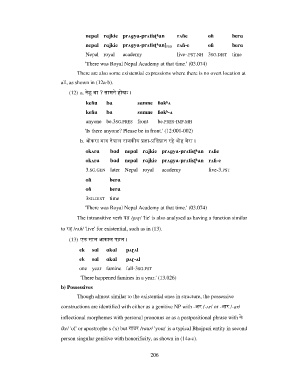
nepɑl  rɑjkie  prʌɡyɑ-prʌtisʈʰɑn      rʌɦe         oɦ        berɑ
                                     nepɑl  rɑjkie  prʌɡyɑ-prʌtisʈʰɑn] PRD  rʌɦ-e       oɦ        berɑ

                                     Nepal  royal   academy                live-.PST.NH  3SG.DIST  time
                                     'There was Royal Nepal Academy at that time.' (03.074)
                                 There are also some existential expressions where there is no overt location at

                           all, as shown in (12a-b).

                              (12) a. केZ बा ? सामने होखऽ ।
                                      keɦu    bɑ           sɑmne  ɦokʰʌ

                                      keɦu    bɑ           sɑmne  ɦokʰ-ʌ
                                      anyone  be.3SG.PRES  front   be.PRES-IMP.MH

                                     'Is there anyone? Please be in front.' (12:001-002)
                                   b. ओकरा बाद नेपाल राजकWय RXा-RितYान रहे ओह बेरा ।

                                     okʌrɑ     bɑd  nepɑl  rɑjkie  prʌɡyɑ-prʌtisʈʰɑn  rʌɦe
                                     okʌrɑ     bɑd  nepɑl  rɑjkie  prʌɡyɑ-prʌtisʈʰɑn  rʌɦ-e

                                     3.SG.GEN  later  Nepal  royal   academy            live-3.PST

                                     oɦ        berɑ
                                     oɦ        berɑ
                                     3SG.DIST  time

                                     'There was Royal Nepal Academy at that time.' (03.074)
                                 The intransitive verb पड़ /pʌɽ/ 'lie' is also analysed as having a function similar

                           to रह /rʌɦ/ 'live' for existential, such as in (13).

                              (13) एक साल आकाल पड़ल ।

                                  ek   sɑl   ɑkɑl     pʌɽʌl
                                  ek    sɑl   ɑkɑl    pʌɽ-ʌl
                                  one  year  famine  fall-3SG.PST

                                   'There happened famines in a year.' (13.026)
                           b) Possessives

                                 Though almost similar to the existential ones in structure, the possessive
                           constructions are identified with either as a genitive NP with -अर /-ʌr/ or -आर /-ɑr/

                           inflectional morphemes with personal pronouns or as a postpositional phrase with के

                           /ke/ 'of' or apostrophe s ('s) but राउर /rɑur/ 'your' is a typical Bhojpuri entity in second

                           person singular genitive with honorificity, as shown in (14a-c).


                                                                206

