


Page 252 - A GRAMMAR OF BHOJPURI _ PhD Dissertation 2020 TU
P. 252
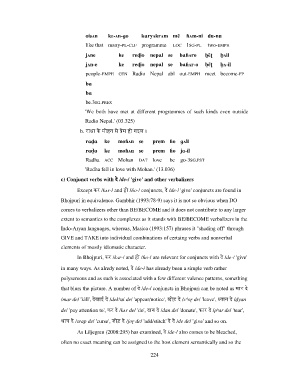
oisʌn    kɛ-ʌn-ɡo      kɑryʌkrʌm  mẽ  ɦʌm-ni  du-nu
                                     like that  many-PL-CLF  programme   LOC  1SG-PL  two-EMPH

                                     jʌne          ke   reɖio  nepɑl  se    bɑɦʌro     b ̤ ẽʈ   b ̤ ʌil
                                     jʌn-e         ke   reɖio  nepɑl  se    bɑɦʌr-o    b ̤ ẽʈ   b ̤ ʌ-il

                                     people-EMPH  GEN  Radio  Nepal  abl  out-EMPH  meet  become-PP

                                     bɑ
                                     bɑ
                                     be.3SG.PRES
                                     'We  both  have  met  at  different  programmes  of  such  kinds  even  outside

                                     Radio Nepal.' (03.325)
                                   b. राधा के मोहन से Rेम हो गइल ।

                                     rɑd ̤ ɑ   ke   moɦʌn  se    prem  ɦo  ɡʌil

                                     rɑd ̤ ɑ   ke   moɦʌn  se    prem  ɦo  jɑ-il
                                     Radha  ACC  Mohan  DAT  love       be  go-3SG.PST
                                     'Radha fell in love with Mohan.' (13.036)

                           c) Conjunct verbs with दे /de-/ 'give' and other verbalizers

                                 Except कर /kʌr-/ and हो /ɦo-/ conjuncts, दे /de-/ 'give' conjuncts are found in

                           Bhojpuri in equivalence. Gambhir (1993:78-9) says it is not so obvious when DO
                           comes to verbalizers other than BE/BECOME and it does not contribute to any larger
                           extent to semantics to the complexes as it stands with BE/BECOME verbalizers in the

                           Indo-Aryan languages, whereas, Masica (1993:157) phrases it "shading off" through
                           GIVE and TAKE into individual combinations of certaing verbs and nonverbal

                           elements of mostly idiomatic character.
                                 In Bhojpuri, कर /kʌr-/ and हो /ɦo-/ are relevant for conjuncts with दे /de-/ 'give'

                           in many ways. As alredy noted, दे /de-/ has already been a simple verb rather

                           polysemous and as such is associated with a few different valence patterns, something
                           that blurs the picture. A number of दे /de-/ conjuncts in Bhojpuri can be noted as मार दे


                           /mɑr de/ 'kill', देखाई दे /dekʰɑi de/ 'appear/notice', छोड़ दे /cʰoɽ de/ 'leave', uयान दे /d ̤ yɑn
                           de/ 'pay attention to', कर दे /kʌr de/ 'do', दान दे /dɑn de/ 'donate', फार दे /pʰɑr de/ 'tear',

                           vाप दे /srɑp de/ 'curse', जोड़ दे /joɽ de/ 'add/stitch' दे दे /de de/ 'give' and so on.

                                 As Liljegren (2008:295) has examined, दे /de-/ also comes to be bleached,

                           often no exact meaning can be assigned to the host element semantically and so the

                                                                224

