


Page 564 - A GRAMMAR OF BHOJPURI _ PhD Dissertation 2020 TU
P. 564
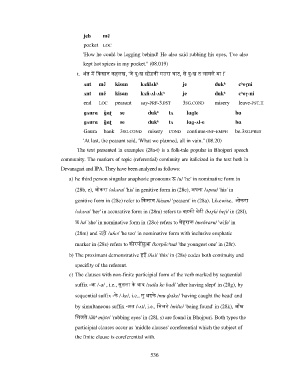
jeb mẽ
pocket LOC
'How he could be lagging behind! He also said rubbing his eyes, 'I've also
kept hot spices in my pocket.'' (08.019)
t. अंत म1 *कसान कहलख, जे दुःख छोड़नी गउरा घाट, से दुःख त लागले बा !
ʌnt mẽ kisɑn kʌɦlʌkʰ je dukʰ cʰoɽni
ʌnt mẽ kisɑn kʌɦ-ʌl-ʌkʰ je dukʰ cʰoɽ-ni
end LOC peasant say-PRF-3.PST 3SG.COND misery leave-PST.H
ɡʌurɑ ɡ ̈ ɑʈ se dukʰ tʌ lɑɡle bɑ
ɡʌurɑ ɡ ̈ ɑʈ se dukʰ tʌ lɑɡ-ʌl-e bɑ
Gaura bank 3SG.COND misery COND continue-INF-EMPH be.3SG.PRES
'At last, the peasant said, 'What we planned, all in vain.'' (08.20)
The text presented in examples (28a-t) is a folk-tale popular in Bhojpuri speech
community. The markers of topic (referential) continuity are italicized in the text both in
Devanagari and IPA. They have been analyzed as follows:
a) he third person singular anaphoric pronouns ऊ /u/ 'he' in nominative form in
(28b, e), ओकरा /okʌrɑ/ 'his' in genitive form in (28c), अपना /ʌpnɑ/ 'his' in
genitive form in (28e) refer to *कसान /kisɑn/ 'peasant' in (28a). Likewise, ओकरा
/okʌrɑ/ 'her' in accusative form in (28m) refers to बड़कb बेटी /bʌɽki beʈi/ in (28l),
ऊ /u/ 'she' in nominative form in (28o) refers to मेहराh /meɦrɑru/ 'wife' in
(28m) and उहो /uɦo/ 'he too' in nominative form with inclusive emphatic
marker in (28s) refers to कोरपYछुआ /korpõcʰuɑ/ 'the youngest one' in (28r).
b) The proximant demonstrative हई /ɦʌi/ 'this' in (28s) codes both continuity and
specifity of the referent.
c) The clauses with non-finite participial form of the verb marked by sequential
suffix -आ /-ɑ/ , i.e., सुतला के बाद /sutlɑ ke bad/ 'after having slept' in (28g), by
sequential suffix -के /-ke/, i.e., मु धइके /mu d ̤ ʌike/ 'having caught the head' and
by simultaneous suffix -अत /-ʌt/, i.e., िमलते /milte/ 'being found' in (28k), आँख
̃
िमजते /ɑkʰ mijte/ 'rubbing eyes' in (28l, s) are found in Bhojpuri. Both types the
participial clauses occur as 'middle clauses' coreferential which the subject of
the finite clause is coreferential with.
536

