


Page 567 - A GRAMMAR OF BHOJPURI _ PhD Dissertation 2020 TU
P. 567
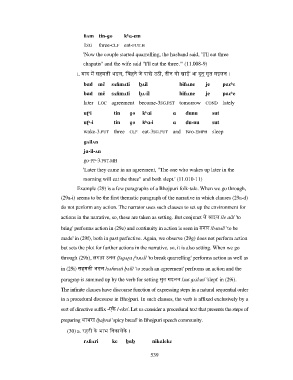
ɦʌm tin-ɡo kʰɑ-em
1SG three-CLF eat-FUT.H
'Now the couple started quarrelling, the husband said, "I'll eat three
chapatis" and the wife said "I'll eat the three."' (11.008-9)
i. बाद म1 सहमती भइल, िबहने जे पाछे उठी, तीन गो खाई आ दुनू सुत गइलन ।
bɑd mẽ sʌɦmʌti b ̤ ʌil biɦʌne je pɑcʰe
bɑd mẽ sʌɦmʌti b ̤ ʌ-il biɦʌne je pɑcʰe
later LOC agreement become-3SG.PST tomorrow COND lately
uʈʰi tin ɡo kʰɑi ɑ dunu sut
uʈʰ-i tin ɡo kʰɑ-i ɑ du-nu sut
wake-3.FUT three CLF eat-3SG.FUT and two-EMPH sleep
ɡʌilʌn
jɑ-il-ʌn
go-PP-3.PST.MH
'Later they came in an agreement, "The one who wakes up later in the
morning will eat the three" and both slept.' (11.010-11)
Example (29) is a few paragraphs of a Bhojpuri folk-tale. When we go through,
(29a-i) seems to be the first thematic paragraph of the narrative in which clauses (29a-d)
do not perform any action. The narrator uses such clauses to set up the environment for
actions in the narrative, so, these are taken as setting. But conjunct ले आइल /le ɑil/ 'to
bring' performs action in (29e) and continuity in action is seen in बनल /bʌnʌl/ 'to be
made' in (29f), both in past perfective. Again, we observe (29g) does not perform action
but sets the plot for further actions in the narrative, so, it is also setting. When we go
through (29h), झगड़ा ठनल /ȷ ̈ ʌɡʌɽɑ ʈʰʌnʌl/ 'to break quarrelling' performs action as well as
in (29i) सहमती भइल /sʌɦmʌti b ̤ ʌil/ 'to reach an agreement' perfroms an action and the
paragrap is summed up by the verb for setting सुत गइलन /sut ɡʌilʌn/ 'slept' in (29i).
The infinite clauses have discourse function of expressing steps in a natural sequential order
in a procedural discourse in Bhojpuri. In such clauses, the verb is affixed exclusively by a
sort of directive suffix -एके /-eke/. Let us consider a procedural text that presents the steps of
preparing भाभरा /b ̤ ɑb ̤ rɑ/ 'spicy bread' in Bhojpuri speech community.
(30) a. रहरी के भाभ िनकालेके ।
rʌɦʌri ke b ̤ ɑb ̤ nikɑleke
539

