


Page 559 - A GRAMMAR OF BHOJPURI _ PhD Dissertation 2020 TU
P. 559
in (27a). The suffix -वा /-wɑ/ with दुपहर /dupʌɦʌr/ afternoon in (27b), -इआ /-iɑ/ with
̃
साँझ /sɑȷ ̈ / evening in (27c) and -का /-kɑ/ with बड़ /bʌɽ/ in (27d) code the adverbs and
the adjective as definite. Similarly, the numeral एगो /eɡo/ one-CLF codes the
adjective मीठ /miʈʰ/ sweet as indefinite in (27e) and the suffix -आवा /-ɑwɑ/ with the
same adjective in (27f) codes it as definite.
14.5 Topic (referential) continuity
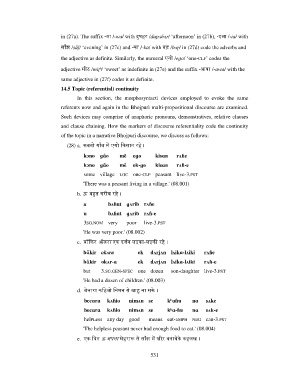
In this section, the morphosyntacti devices employed to evoke the same
referents now and again in the Bhojpuri multi-propositional discourse are examined.
Such devices may comprise of anaphoric pronouns, demonstratives, relative clauses
and clause chaining. How the markers of discourse referentiality code the continuity
of the topic in a narrative Bhojpuri discourse, we discuss as follows:
(28) a. कवनो गाँव म1 एगो *कसान रहे ।
kɔno ɡɑ ̃ o mẽ eɡo kisɑn rʌɦe
kɔno ɡɑ ̃ o mẽ ek-ɡo kisɑn rʌɦ-e
some village LOC one-CLF peasant live-3.PST
'There was a peasant living in a village.' (08.001)
b. ऊ ब5त गरीब रहे ।
u bʌɦut ɡʌrib rʌɦe
u bʌɦut ɡʌrib rʌɦ-e
3SG.NOM very poor live-3.PST
'He was very poor.' (08.002)
c. बाँ*कर ओकरा एक दजgन लइका-लइकb रहे ।
bɑ ̃ kir okʌrɑ ek dʌrjʌn lʌikɑ-lʌiki rʌɦe
bɑ ̃ kir okʌr-ɑ ek dʌrjʌn lʌikɑ-lʌiki rʌɦ-e
but 3.SG.GEN-SPEC one dozen son-daughter live-3.PST
'He had a dozen of children.' (08.003)
d. बेचारा किहओ िनमन से खा5 ना सके ।
becɑrɑ kʌɦio nimʌn se kʰɑɦu nɑ sʌke
becɑrɑ kʌɦio nimʌn se kʰɑ-ɦu nɑ sʌk-e
helPLess any day good means eat-EMPH NEG can-3.PST
'The helpless peasant never had enough food to eat.' (08.004)
e. एक *दन ऊ अपना मेहराh से साँझ म1 खीऱ बनावेके कहलख ।
531

