


Page 556 - A GRAMMAR OF BHOJPURI _ PhD Dissertation 2020 TU
P. 556
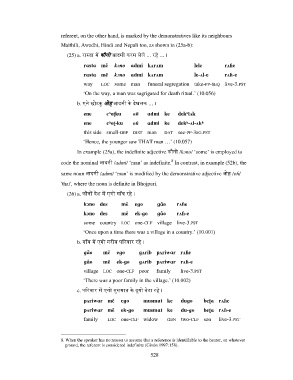
referent, on the other hand, is marked by the demonstratives like its neighbours
Maithili, Awadhi, Hindi and Nepali too, as shown in (25a-b):
(25) a. राfता म1 कौनो आदमी करम लेले ... रहे ... ।
rɑstɑ mẽ kɔno ɑdmi kʌrʌm lele rʌɦe
rɑstɑ mẽ kɔno ɑdmi kʌrʌm le-ʌl-e rʌɦ-e
way LOC some man funeral segregation take-PP-SEQ live-3.PST
On the way, a man was sagrigated for death ritual. (10.056)
b. एने छोटकु ओह आदमी के देखलक ... ।
ene cʰoʈku oɦ ɑdmi ke dekʰlʌk
ene cʰoʈ-ku oɦ ɑdmi ke dekʰ-ʌl-ʌkʰ
this side small-DEF DIST man DAT see-PP-3SG.PST
Hence, the younger saw THAT man
(10.057)
In example (25a), the indefinite adjective कौनो /kɔno/ some is employed to
8
code the nominal आदमी /ɑdmi/ man as indefinite. In contrast, in example (52b), the
same noun आदमी /ɑdmi/ man is modified by the demonstrative adjective ओह /oɦ/
'that', where the noun is definite in Bhojpuri.
(26) a. कौनY देश म1 एगो गाँव रहे ।
kɔno des mẽ eɡo ɡɑ ̃ o rʌɦe
kɔno des mẽ ek-ɡo ɡɑ ̃ o rʌɦ-e
some country LOC one-CLF village live-3.PST
Once upon a time there was a village in a country. (10.001)
b. गाँव म1 एगो गरीब प[रवार रहे ।
ɡɑ ̃ o mẽ eɡo ɡʌrib pʌriwɑr rʌɦe
ɡɑ ̃ o mẽ ek-ɡo ɡʌrib pʌriwɑr rʌɦ-e
village LOC one-CLF poor family live-3.PST
There was a poor family in the village. (10.002)
c. प[रवार म1 एगो मुसमात के दूगो बेटा रहे ।
pʌriwɑr mẽ eɡo musmɑt ke duɡo beʈɑ rʌɦe
pʌriwɑr mẽ ek-ɡo musmɑt ke du-ɡo beʈɑ rʌɦ-e
family LOC one-CLF widow GEN two-CLF son live-3.PST
8. When the speaker has no reason to assume that a reference is identifiable to the hearer, on whatever
ground, the referent is considered indefinite (Givón 1997:158).
528

