


Page 418 - A GRAMMAR OF BHOJPURI _ PhD Dissertation 2020 TU
P. 418
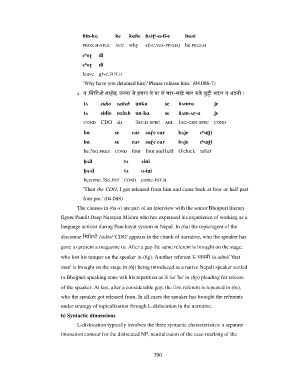
ɦin-kɑ       ke    kɑɦe  bʌiʈʰ-ɑ-il-e     bɑni
                                    PROX.H-SPEC  ACC  why     sit-CAUS-PP-SEQ  be.PRES.H

                                    cʰoɽ   dĩ
                                    cʰoɽ   dĩ

                                    leave  give.FUT.H
                                    'Why have you detained him? Please release him.' (04.086-7)

                                 s.  त िसिडओ साहेब, उनका से हमरा जे बा से चार-साढ़े चार बजे छु`ी भइल त अइनी ।
                                    tʌ     sidio  sɑɦeb  unkɑ         se    ɦʌmrɑ          je

                                    tʌ     sidio  sɑɦeb  un-kɑ        se    ɦʌm-ʌr-ɑ      je
                                    COND  CDO  sir        3SG.H-SPEC  ABL  1SG-GEN-SPEC  COND


                                    bɑ           se     cɑr  sɑɽ ̊ e cɑr    bʌje     cʰuʈʈi
                                    bɑ           se     cɑr  sɑɽ ̊ e cɑr    bʌje     cʰuʈʈi

                                    be.3SG.PRES  COND  four  four and half  O'clock  relief

                                    b ̤ ʌil          tʌ     ʌini
                                    b ̤ ʌ-il         tʌ     ɑ-ini
                                    become-3SG.PST  COND  come-PST.H

                                    'Then the CDO, I got released from him and came back at four or half past
                                    four pm.' (04.088)

                                 The clauses in (6a-s) are part of an interview with the senior Bhojpuri literary
                           figure Pandit Deep Narayan Mishra who has expressed his experience of working as a
                           language activist during Panchayat system in Nepal. In (6a) the topic/agent of the

                           discourse िसिडयो /sidio/ 'CDO' appears in the chunk of narrative, who the speaker has

                           gone to present a magazine to. After a gap the same referent is brought on the stage,
                           who lost his temper on the speaker in (6g). Another referent ऊ आदमी /u ɑdmi/ 'that

                           man' is brought on the stage in (6j) being introduced as a native Nepali speaker settled

                           in Bhojpuri speaking zone wih his repetition as ऊ /u/ 'he' in (6p) pleading for release
                           of the speaker. At last, after a considerable gap, the first referent is repeated in (6s),

                           who the speaker got released from. In all cases the speaker has brought the referents
                           under strategy of topicalization through L-dislocation in the narrative.

                           b) Syntactic dimensions
                                 L-dislocation typically involves the three syntactic characteristics: a separate
                           intonation contour for the dislocated NP, neutralizaion of the case-marking of the


                                                                    390

