


Page 192 - A GRAMMAR OF BHOJPURI _ PhD Dissertation 2020 TU
P. 192
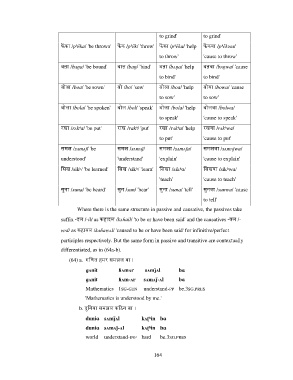
to grind'         to grind'

                           फ) का /pʰẽkɑ/ 'be thrown'  फ) क /pʰẽk/ 'throw'  फ) का /pʰẽkɑ/ 'help   फ) कवा /pʰẽkwɑ/
                                                                    to throw'         'cause to throw'

                           बऩा /bʌn ̥ ɑ/ 'be bound'   बाऩ /bɑn ̥ / 'bind'   बऩा /bʌn ̥ ɑ/ 'help   बऩवा /bʌn ̥ wɑ/ 'cause

                                                                    to bind'          to bind'
                           बोआ /boɑ/ 'be sown'    बो /bo/ 'sow'     बोआ /boɑ/ 'help   बोवा /bowɑ/ 'cause

                                                                    to sow'           to sow'

                           बोला /bolɑ/ 'be spoken'   बोल /bol/ 'speak'  बोला /bolɑ/ 'help   बोलवा /bolwɑ/
                                                                    to speak'         'cause to speak'

                           रखा /rʌkʰɑ/ 'be put'   राख /rɑkʰ/ 'put'   रखा /rʌkʰɑ/ 'help   रखवा /rʌkʰwɑ/

                                                                    to put'           'cause to put'
                           समझ /sʌmʌȷ ̈ / 'be     समझ /sʌmʌȷ ̈ /    समझा /sʌmʌȷ ̈ ɑ/   समझवा /sʌmʌȷ ̈ wɑ/

                           understood'            'understand'      'explain'         'cause to explain'

                           िसख /sikʰ/ 'be learned'   िसख /sikʰ/ 'learn'  िसखा /sikʰɑ/   िसखवा /sikʰwɑ/
                                                                    'teach'           'cause to teach'

                           सुना /sunɑ/ 'be heard'   सुन /sun/ 'hear'   सुना /sunɑ/ 'tell'   सुनवा /sunwɑ/ 'cause

                                                                                      to tell'
                                 Where there is the same structure in passive and causative, the passives take

                           suffix -इल /-il/ as कहाइल /kʌɦɑil/ 'to be or have been said' and the causatives -वल /-

                           wʌl/ as कहावल /kʌɦɑwʌl/ 'caused to be or have been said' for infinitive/perfect
                           participles respectively. But the same form in passive and transitive are contextually
                           differentiated, as in (64a-b).

                              (64) a.  गिणत हमर समझल बा ।

                                     ɡʌnit         ɦʌmʌr     sʌmȷ ̈ ʌl     bɑ
                                     ɡʌnit         ɦʌm-ʌr    sʌmʌȷ ̈ -ʌl    bɑ

                                     Mathematics  1SG-GEN  understand-PP  be.3SG.PRES
                                     'Mathematics is understood by me.'
                                  b. दुिनया समझल कCठन बा ।

                                     duniɑ  sʌmȷ ̈ ʌl       kʌʈʰin  bɑ

                                     duniɑ  sʌmʌȷ ̈ -ʌl     kʌʈʰin  bɑ
                                     world  understand-INF  hard    be.3SG.PRES


                                                                    164

