


Page 190 - A GRAMMAR OF BHOJPURI _ PhD Dissertation 2020 TU
P. 190
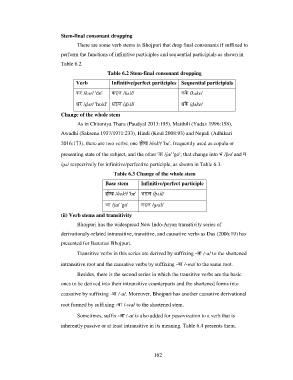
Stem-final consonant dropping
                                 There are some verb stems in Bhojpuri that drop final consonants if suffixed to

                           perform the functions of infinitive participles and sequential participials as shown in
                           Table 6.2.

                                              Table 6.2 Stem-final consonant dropping
                                 Verb           Infinitive/perfect participles  Sequential participials

                                 कर /kʌr/ 'do'   कइल /kʌil/                  कके /kʌke/

                                 धर /d ̤ ʌr/ 'hold'  धइल /d ̤ ʌil/           धके /d ̤ ʌke/
                           Change of the whole stem

                                 As in Chitoniya Tharu (Paudyal 2013:195), Maithili (Yadav 1996:158),
                           Awadhi (Saksena 1937/1971:233), Hindi (Koul 2008:93) and Nepali (Adhikari

                           2016:173), there are two verbs; one होख /ɦokʰ/ 'be', frequently used as copula or
                           presenting state of the subject, and the other जा /jɑ/ 'go'; that change into भ /b ̤ ʌ/ and ग

                           /ɡʌ/ respectively for infinitive/perfective participle, as shown in Table 6.3.

                                                 Table 6.3 Change of the whole stem
                                             Base stem      Infinitive/perfect participle

                                             होख /ɦokʰ/ 'be'  भइल /b ̤ ʌil/

                                             जा /jɑ/ 'go'   गइल /ɡʌil/

                           (ii) Verb stems and transitivity
                                 Bhojpuri has the widespread New Indo-Aryan transitivity series of
                           derivationaly-related intransitive, transitive, and causative verbs as Das (2006:19) has

                           presented for Banarasi Bhojpuri.

                                 Transitive verbs in this series are derived by suffixing -आ /-ɑ/ to the shortened
                           intransitive root and the causative verbs by suffixing -वा /-wɑ/ to the same root.

                                 Besides, there is the second series in which the transitive verbs are the basic
                           ones to be derived into their intransitive counterparts and the shortened forms into

                           causative by suffixing -आ /-ɑ/. Moreover, Bhojpuri has another causative derivational

                           root formed by suffixing -वा /-wɑ/ to the shortened stem.

                                 Sometimes, suffix -आ /-ɑ/ is also added for passivization to a verb that is
                           inherently passive or at least intransitive in its meaning. Table 6.4 presents them.


                                                                    162

