


Page 188 - A GRAMMAR OF BHOJPURI _ PhD Dissertation 2020 TU
P. 188
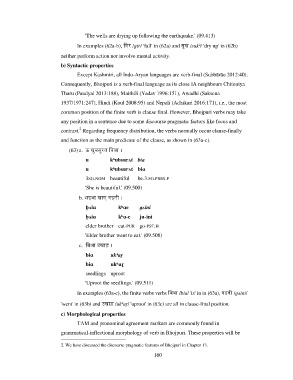
'The wells are drying up following the earthquake.' (09.413)
                                 In examples (62a-b), िगर /ɡir/ 'fall' in (62a) and सुख /sukʰ/ 'dry up' in (62b)

                           neither perform action nor involve mental activity.
                           b) Syntactic properties

                                 Except Kashmiri, all Indo-Aryan languages are verb-final (Subbārāo 2012:40).
                           Consequently, Bhojpuri is a verb-final language as its close IA neighbours Chitoniya

                           Tharu (Paudyal 2013:188), Maithili (Yadav 1996:151), Awadhi (Saksena
                           1937/1971:247), Hindi (Koul 2008:95) and Nepali (Adhikari 2016:171), i.e., the most

                           common position of the finite verb is clause final. However, Bhojpuri verbs may take
                           any position in a sentence due to some discourse pragmatic factors like focus and
                                  2
                           contrast.  Regarding frequency distribution, the verbs normally occur clause-finally
                           and function as the main predicate of the clause, as shown in (63a-c).

                              (63) a.  ऊ खुबसुरत िबआ ।
                                     u         kʰubsurʌt  biɑ

                                     u         kʰubsurʌt  biɑ
                                     3SG.NOM  beautiful    be.3.SG.PRES.F
                                     'She is beautiful.' (09.500)

                                  b. भइआ खाए गइनी ।

                                     b ̤ ʌiɑ      kʰɑe     ɡʌini
                                     b ̤ ʌiɑ      kʰɑ-e    jɑ-ini
                                     elder brother  eat-PUR  go-PST.H

                                     'Elder brother went to eat.' (09.508)
                                  c.  िबआ उखाड़ ।

                                     biɑ       ukʰɑɽ
                                     biɑ       ukʰɑɽ

                                     seedlings  uproot
                                     'Uproot the seedlings.' (09.511)

                                 In examples (63a-c), the finite verbs verbs िबआ /biɑ/ 'is' in in (63a), गइनी /ɡʌini/

                           'went' in (63b) and उखाड़ /ukʰɑɽ/ 'uproot' in (63c) are all in clause-final position.
                           c) Morphological properties

                                 TAM and pronominal agreement markers are commonly found in
                           grammatical-inflectional morphology of verb in Bhojpuri. These properties will be

                           2. We have discussed the discourse pragmatic features of Bhojpuri in Chapter 13.

                                                                    160

