


Page 189 - A GRAMMAR OF BHOJPURI _ PhD Dissertation 2020 TU
P. 189
discussed in the subsequent chapters (Ch. 8 and 10). Here, some important classes of
                           the verb stems and derivations from them are introduced.

                           (i) Verb stems
                                 A verb stem in Bhojpuri without any affixes is used in the imperative,
                           generally without honorificity of the subject, otherwise may be directly affixed to by

                           number-gender agreement markers with the subject in accordance with the tense,
                           aspect and mood markers at the same time. As Chitoniya Tharu (Paudyal 2013:187),

                           Maithili (Yadav 1996:154), Awadhi (Saksena 1937/1971:232), Hindi (Koul 2008:95)
                           and Nepali (Adhikari 2016:187-9); Bhojpuri verb stems have morphophonemic

                           changes in the following ways to perform different functions:
                           Vowel alternation

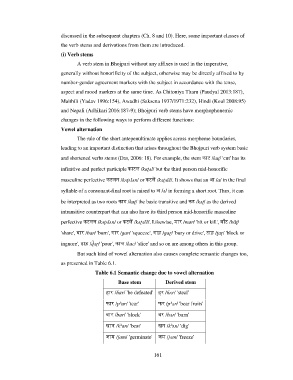
                                 The rule of the short antepenultimate applies across morpheme boundaries,
                           leading to an important distinction that arises throughout the Bhojpuri verb system basic

                           and shortened verbs stems (Das, 2006: 18). For example, the stem काट /kɑʈ/ 'cut' has its

                           infinitive and perfect participle काटल /kɑʈʌl/ but the third person mid-honorific
                           masculine perfective कटलन /kʌʈʌlʌn/ or कटल) /kʌʈʌlẽ/. It shows that an आ /ɑ/ in the final

                           syllable of a consonant-final root is raised to अ /ʌ/ in forming a short root. Thus, it can

                           be interpreted as two roots काट /kɑʈ/ the basic transitive and कट /kʌʈ/ as the derived

                           intransitive counterpart that can also have its third person mid-honorific masculine
                                                                                                   ̃
                           perfective कटलन /kʌʈʌlʌn/ or कटल) /kʌʈʌlẽ/. Likewise, मार /mɑr/ 'hit or kill', बाँट /bɑʈ/
                           'share', बार /bɑr/ 'burn', गार /ɡɑr/ 'squeeze', गाड़ /ɡɑɽ/ 'bury or drive', टाड़ /ʈɑɽ/ 'block or
                                        ̈
                           ingnore', ढाड़ /ɖʌɽ/ 'pour', काच /kɑc/ 'slice' and so on are among others in this group.

                                 But such kind of vowel alternation also causes complete semantic changes too,
                           as presented in Table 6.1.
                                         Table 6.1 Semantic change due to vowel alternation

                                                  Base stem           Derived stem

                                             हार /ɦɑr/ 'be defeated'  हर /ɦʌr/ 'steal'

                                             फार /pʰɑr/ 'tear'     फर /pʰʌr/ 'bear fruits'

                                             बार /bɑr/ 'block'     बर /bʌr/ 'burn'
                                             खान /kʰɑn/ 'beat'     खन /kʰʌn/ 'dig'

                                             जाम /jɑm/ 'germinate'  जम /jʌm/ 'freeze'


                                                                    161

