


Page 196 - A GRAMMAR OF BHOJPURI _ PhD Dissertation 2020 TU
P. 196
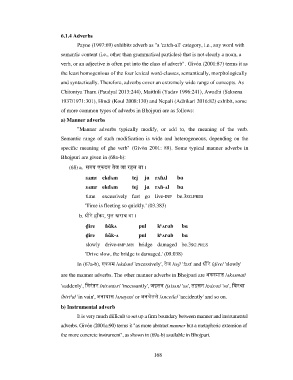
6.1.4 Adverbs
                                 Payne (1997:69) exhibits adverb as "a 'catch-all' category, i.e., any word with

                           semantic content (i.e., other than grammatical particles) that is not clearly a noun, a
                           verb, or an adjective is often put into the class of adverb". Givón (2001:87) terms it as
                           the least homogenious of the four lexical word-classes, semantically, morphologically

                           and syntactically. Therefore, adverbs cover an extremely wide range of concepts. As
                           Chitoniya Tharu (Paudyal 2013:244), Maithili (Yadav 1996:241), Awadhi (Saksena

                           1937/1971:301), Hindi (Koul 2008:130) and Nepali (Adhikari 2016:82) exhibit, some
                           of more common types of adverbs in Bhojpuri are as follows:

                           a) Manner adverbs
                                 "Manner  adverbs  typically  modify,  or  add  to,  the  meaning  of  the  verb.

                           Semantic range  of  such modification  is wide  and  heterogeneous, depending  on  the
                           specific  meaning  of  ghe  verb"  (Givón  2001:  88).  Some  typical  manner  adverbs  in
                           Bhojpuri are given in (68a-b):

                              (68) a.  समय एकदम तेज जा रहल बा ।

                                     sʌmɛ  ekdʌm        tej  jɑ  rʌɦʌl    bɑ
                                     sʌmɛ  ekdʌm        tej  jɑ  rʌɦ-ʌl    bɑ

                                     time   excessively  fast  go  live-INF  be.3SG.PRES
                                     'Time is fleeting so quickly.' (03.383)

                                  b. धीरे हाँकऽ, पुल खराब बा ।
                                     d ̤ ire   ɦɑ ̃ kʌ      pul    kʰʌrɑb    bɑ

                                     d ̤ ire   ɦɑ ̃ k-ʌ    pul     kʰʌrɑb    bɑ
                                     slowly  drive-IMP.MH  bridge  damaged  be.3SG.PRES

                                     'Drive slow, the bridge is damaged.' (09.038)
                                 In (67a-b), एकदम /ekdʌm/ 'excessively', तेज /tej/ 'fast' and धीरे /d ̤ ire/ 'slowly'

                           are the manner adverbs. The other manner adverbs in Bhojpuri are अकXमात /ʌkʌsmɑt/

                           'suddenly', िनरंतर /nirʌntʌr/ 'incessantly', जइसन /jʌisʌn/ 'as', तइसन /tʌisʌn/ 'so', िबरथा

                           /birtʰɑ/ 'in vain', अनायास /ʌnɑyɑs/ or अनचेतले /ʌncetle/ 'accidently' and so on.

                           b) Instrumental adverb
                                 It is very much difficult to set up a firm boundary between manner and instrumental
                           adverbs. Givón (2001a:90) terms it "as more abstract manner but a metaphoric extension of

                           the more concrete instrument", as shown in (69a-b) available in Bhojpuri.


                                                                    168

