


Page 198 - A GRAMMAR OF BHOJPURI _ PhD Dissertation 2020 TU
P. 198
rʌɦ-e-ʌl-u
                                    live-PRES-INF-2.F

                                    'Why do you always remember your brother?' (10.074)
                                 In example (70a-b) कबोकाल /kʌbokɑl/ 'seldom' and हरदम /ɦʌrdʌm/ 'always' are

                           the time adverbs respectively. Likewise, आजु /ɑju/ 'today', काt /kɑl ̥ / 'yesterday', िबहान

                           /biɦɑn/ 'tomorrow', अब /ʌb/ 'now', तब /tʌb/ 'then', कब /kʌb/ 'when' and so on are the

                           time adverbs in Bhojpuri.
                           d) Adverbs modifying adjectives

                                 "A distinct class of adverbs are used to quantify the extent of adjectives"
                           (Givón 2001a:94). Some adverbs that function as modifying adjectives in Bhojpuri
                           are listed in (71a-b).

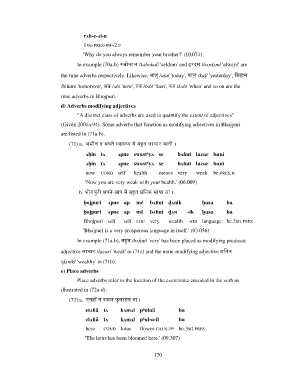
                              (71) a.  अभीन त अपने XवाX{य से बzत लाचार बानी ।

                                     ʌb ̤ in  tʌ   ʌpne  swɑstʰyʌ  se      bʌɦut  lɑcɑr  bɑni
                                     ʌb ̤ in  tʌ   ʌpne  swɑstʰyʌ  se      bʌɦut  lɑcɑr  bɑni
                                     now   COND  self    health    means  very     weak  be.PRES.H

                                     'Now you are very weak with your health.' (06.009)

                                  b. भोजपुरी अपने-आप म) बzत धिनक भाषा बा ।
                                    b ̤ ojpuri  ʌpne  ɑp  mẽ  bʌɦut  d ̤ ʌnik        b ̤ ɑsɑ    bɑ

                                    b ̤ ojpuri  ʌpne  ɑp  mẽ  bʌɦut  d ̤ ʌn    -ik   b ̤ ɑsɑ    bɑ
                                    Bhojpuri  self   self  LOC  very   wealth  -ADJ  language  be.3SG.PRES

                                    'Bhojpuri is a very prosperous language in itself.' (03.056)
                                 In example (71a-b), बzत /bʌɦut/ 'very' has been placed as modifying predicate

                           adjective लाचार /lɑcɑr/ 'weak' in (71a) and the noun-modifying adjective धिनक

                           /d ̤ ʌnik/ 'wealthy' in (71b).
                           e) Place adverbs
                                 Place adverbs refer to the location of the event/state encoded in the verb as

                           illustrated in (72a-d):

                              (72) a.  एतहाँ त कमल फु लाइल बा ।
                                     etʌɦɑ ̃   tʌ   kʌmʌl  pʰulɑil          bɑ

                                     etʌɦɑ ̃   tʌ   kʌmʌl  pʰul-ɑ-il        bɑ
                                     here   COND  lotus    flower-CAUS-PP  be.3SG.PRES

                                     'The lotus has been bloomed here.' (09.307)


                                                                    170

